

14 May 2026 · Nina Aramway
People & Culture · Grandmother of ten
Toddler Talk: Helping Your Little One Cope With a New Baby

For a toddler, a new sibling isn't a happy event they're struggling to appreciate.
Preparing a toddler beforehand
Concretely, and later than you think. Under about three a child has very little sense of months, so telling them early creates a long stretch of confusing anticipation, and a few weeks is enough for a two-year-old, while an older three or four-year-old can hold it for longer and will ask better questions.
Describe what will happen, not how they'll feel. "The baby will cry a lot and feed a lot and can't play" is far better preparation than "you'll love being a big brother", which is a promise nobody can keep, and which I made, twice.
Do the disruptive changes early, moving to a bed, starting nursery, giving up a dummy, changing rooms, at least two months ahead, so that none of them gets tied to the baby's arrival in the child's mind, where things get tied together very fast.
Show them a real baby if you possibly can, or photographs of themselves as a newborn, because their idea of a baby is otherwise a toy that sits up and plays, and read a couple of sibling books, including one that admits to the hard parts, since the ones where everybody is delighted throughout aren't preparation for anything.
Tell them who will look after them while you're giving birth, and rehearse it if you can, because in my experience this is the part that worries a toddler most and the part adults most often forget to mention, being busy worrying about the birth.
And don't promise a playmate. It's the commonest piece of preparation there is, and it sets up a disappointment that arrives in week two and stays.
What happens in the first weeks
Usually a delay, and then a reaction. A great many toddlers are curious and cheerful for the first few days and fall apart somewhere in week two or three, when it becomes clear that the baby isn't leaving, and parents read the early calm as adjustment and the later collapse as regression, and it's neither, it's the same process arriving on its own schedule. Expect behavioural regression, which is very common: toilet accidents in a trained child, wanting a bottle, baby talk, night waking, refusing to walk. Expect clinginess to one parent, often the less available one, and rejection of the other, which stings. Expect more aggression, usually aimed at a parent and not the baby, and usually at the exact moment your attention transfers. Expect sleep disruption, which is the most persistent of all of it and the least convenient, and occasionally expect the opposite, an intensely helpful, grown-up little person who's holding it all together and will let go later, and that's the one I watch most carefully, because I was that child. Regression isn't a setback to be corrected. It's a request for care in the form the child associates with being cared for, and meeting it, feeding them, carrying them, letting the toilet training slip for a fortnight, resolves it a great deal faster than holding the line does, whatever your mother-in-law says about spoiling.
The rest of the adjustment
When they hit the baby
Common, frightening for parents, and not a sign of a child who dislikes their sibling. A toddler with strong feelings and no language uses their body, because that's what's available.
It still needs an immediate and unambiguous response, and the point is that the response is about safety and not about punishment.
Intervene physically and at once: block, move, separate, calmly and without a lecture. State the rule in four words, "I won't let you hit", and repeat it identically every time, and then name what was underneath it, because "you wanted me" reduces repetition far more than punishing the act does, and I've tried both.
Never leave a toddler unsupervised with a newborn, however gentle they've been. That's a standing rule in every house I've ever run and it isn't a judgement on your child.
Give them something to do with the feeling, squeeze a cushion, stamp, come and find you, and watch the pattern instead of the incident, because most hitting clusters around feeds and around the exact moment a parent's attention moves, and once you can see the pattern you can get there first.
Giving a toddler enough attention
By making a small amount of it reliable and undivided, not by trying to make it large. Ten predictable minutes with no phone and no baby does more than an hour of distracted presence, because what has been lost is exclusivity and not time, and a two-year-old knows the difference perfectly well.
Protect one short daily slot that belongs to them, at the same point in the day, and give it a name so they can look forward to it. Let the other parent take the baby and not the toddler where you can, because it's usually arranged the wrong way round and the toddler notices immediately. Or so I'm told by my daughters, who have all made the mistake, as I did.
Involve them in baby care in ways that are real, fetching a nappy, choosing the muslin, since token jobs are seen through within days, and don't blame your unavailability on the baby, because "the baby needs me" teaches a child exactly who the obstacle is, while "I'll be there in two minutes" doesn't.
Mentioned above
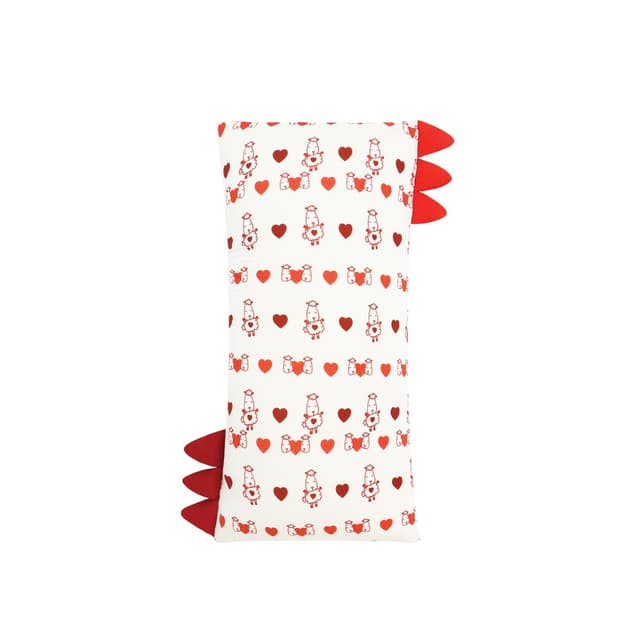 Baa Baa Sheepz Hearts Buddy Pillowfrom S$29.00Shop now
 Junior Blanket (120x180cm)S$105.00Shop now
Take the visitor gifts seriously. Guests arriving with presents for the newborn and nothing at all for the toddler is a real slight and an easily fixed one, and as a grandmother I'd say it's our job to get this right, not the parents', and I keep a drawer of small things for exactly this.
Accept help with the newborn and not the toddler, so that the time it frees goes to the child who's struggling.
How long adjustment takes
Typically weeks to a few months for the sharpest of the behaviour, with sleep the last thing to settle, and progress isn't linear: a good fortnight followed by a bad week is the standard pattern, and the six-to-eight-week mark, when a partner often goes back to work and the visitors stop coming, is a common second dip that nobody warns you about.
Take it to a doctor or health visitor if the behaviour is escalating and not easing after a couple of months, if the child becomes withdrawn or stops eating, or if the aggression can't be managed with ordinary supervision.
Take your own mood there as well. The arrival of a second child is a high-risk period for postnatal depression and anxiety, and in my experience the toddler's difficulty is what gets discussed at every appointment while the parent's goes unmentioned, and I'd rather you mentioned it.
This guide is general information, written to help you understand a topic and ask better questions. It is not medical advice and does not replace your own doctor, midwife or paediatrician. Anything that worries you about your baby belongs with them.