

25 October 2026 · Jennifer Wijaya
Finance Director · Mother of one, expecting
Baby Urine and Wet Diapers: Colour, Frequency, Urates and Dehydration Signs
A newborn should have 1 or 2 wet diapers a day on her first 2 days, rising to 6 or more heavy ones a day by the end of week 1. The target is pale yellow urine with little smell. Fewer diapers than that, dark urine, or pink crystals that last past day 3 are the signals to call someone.
Stool gets most of the attention in the first weeks. Urine is the better daily check on whether she's getting enough milk, because you can count it. I kept the tally in my phone's notes app, next to the feed times.
Wet diapers by day in the first month
| Age | Wet diapers in 24 hours | What else to check |
|---|---|---|
| Days 1–2 | 1–2 or more | Pink or orange urate crystals are common |
| Days 3–4 | 3–4 or more, getting heavier | Urates should be fading |
| Days 5–6 | 5 or more | Heavier, paler urine |
| Day 7 to week 4 | 6 or more, heavy | Pale yellow, little smell |
Those counts come from the breastfeeding checklists. For formula, Unicef's bottle-feeding checklist looks for around 6 heavy, wet diapers a day by day 5, so by the end of week 1 the 2 targets meet. The early days are where breastfed babies differ: the count climbs as the milk comes in, so 1 or 2 on day 1 is expected. Cambridge University Hospitals' guide adds that urates still turning up after the first couple of days can mean a breastfed baby isn't getting enough milk, and the midwife should hear about it.
What "properly wet" means
A disposable diaper pulls urine away from the surface, so a wet one can feel almost dry to the touch. Unicef's health visitor checklist has a fix: pour 2 to 4 tablespoons of water into a clean diaper, about 30 to 60 ml, and feel the weight. That's what a heavy wet diaper should feel like. A diaper that's damp in one spot doesn't count as 1 on the tally.
Colour, from pale to pink
| What you see | What it usually means | What to do |
|---|---|---|
| Pale yellow, little smell | Well hydrated | Nothing |
| Darker yellow, stronger smell | Concentrated urine; she may need more milk | Offer more feeds and keep counting; call if it lasts |
| Pink, orange or brick-red powder, days 1–3 | Urate crystals from concentrated urine | Common early on; tell your midwife or doctor if it's still there after day 3 |
| A small spot of blood, newborn girl, week 1 | Her mother's hormones leaving her system | Usually normal; mention it at the next check |
| Pink or red after week 1, or a red spot | Possibly blood | Call the doctor today |
Urates look alarming. They're tiny salt crystals that leave a pink, orange or brick-red stain, usually in the first few days while the milk is coming in. The AAP says this stain is often mistaken for blood and is usually a sign of very concentrated urine. If she's wetting at least 4 diapers a day there's probably no cause for concern, but if the pink staining goes on, the AAP's advice is to see the paediatrician. Health Canada's schedule, as Eastern Health publishes it, draws the line at day 3: orange crystals after that need a health-care provider.
Blood is a different thing. In the first week a newborn girl can have a small spot of blood in her diaper from her mother's hormones, which the AAP treats as normal. After that week, the AAP says blood in the urine or a bloody spot on the diaper is never normal, and that bleeding with tummy pain, poor feeding or vomiting needs medical attention right away. Not every red mark is urine, either. A rash or a stool can leave one too, so tell the doctor where you saw it.
The other half of the diaper
Strong smell, or crying when she wees
Strong-smelling urine is usually concentrated urine. The NHS lists dark yellow, strong-smelling pee among the signs of dehydration, so the first check is the tally and the feeds. Smell can also be 1 sign of a urinary tract infection. KidsHealth lists foul-smelling, cloudy or bloody pee, and notes that a baby with a UTI may show nothing more than a fever and fussiness. The AAP puts it plainly: weeing should never be painful, and a baby who seems distressed while she wees needs her doctor told. A smell can't confirm a UTI. A urine test can, which makes it the doctor's job.
Fever, diarrhoea and a lighter day
Illness changes the count. The AAP says that during an illness, a fever or very hot weather, a baby's usual urine output may drop by half and still be normal.
So 1 light day isn't a crisis, but it's the day to count carefully. Keep breast or formula feeding, as the NHS advises for diarrhoea and vomiting, offer smaller feeds more often if she's being sick, and don't make formula weaker than the tin says. What turns a lighter day into an urgent one is fewer wet diapers together with the signs in the boxes below. For a baby under 3 months, a temperature of 38°C or more is a reason to call the doctor on its own, whatever the diapers look like.
In Singapore, that second box means the Children's Emergency at KK Women's and Children's Hospital or your nearest A&E, or 995 for an ambulance.
Wetness indicators help, up to a point
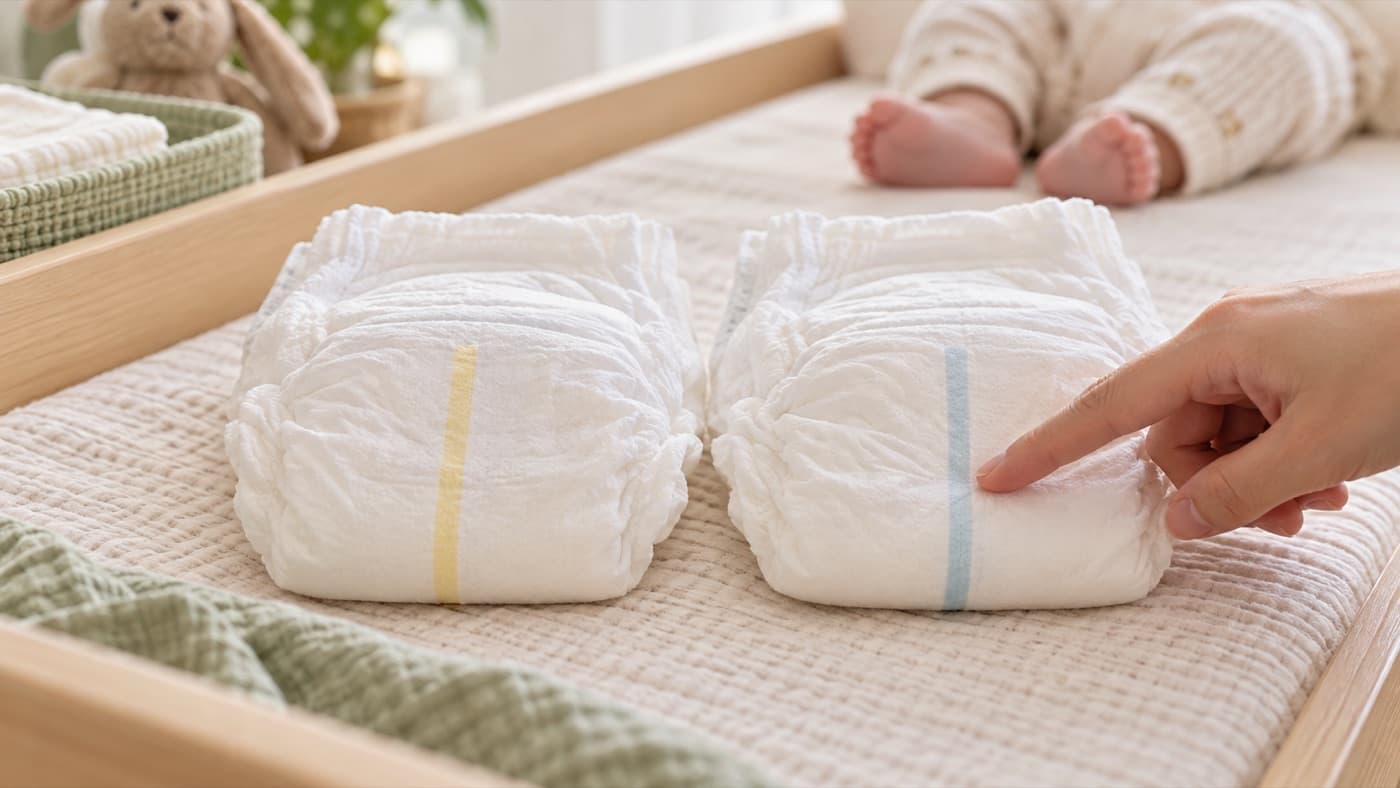
Many diapers have a stripe on the front that changes colour when wet. It's often a dye that reacts to the pH of urine and turns from yellow to blue within a minute or two. That tells you she's weed. It doesn't tell you how much, so 1 small wee and 1 heavy one can look the same. For the tally, weight is the better test: lift the diaper and compare it with the tablespoon test above. Our Little Rei diapers have one too, and I'd still lift the diaper before I trusted the colour.
Keeping count without a spreadsheet
- Count wet diapers per 24 hours, from the same clock time each day.
- Count a diaper only if it feels heavy, by the tablespoon test.
- Note the colour if it's anything other than pale yellow.
- Take a photo of anything pink, orange or red, in daylight, before it goes in the bin.
- Bring the tally to every check in the first month. It answers the first question most midwives ask.
The numbers people ask for
How many wet diapers a day in the first week?
1 to 2 a day on days 1 and 2, 3 to 4 on days 3 and 4, 5 or more on days 5 and 6, and 6 or more heavy wet diapers a day from day 7, according to UK Unicef Baby Friendly and NHS hospital checklists.
Are pink or orange crystals in a newborn's diaper normal?
In the first 2 to 3 days, usually yes. They're urate crystals from concentrated urine. If they're still there after day 3, or she has fewer wet diapers than expected, tell your midwife or doctor.
What colour should baby urine be?
Pale yellow with little smell. Darker, stronger urine is more concentrated and can mean she needs more feeds. Pink or red after the first week can be blood and needs a doctor.
When is no wet diaper an emergency?
When a baby who's unwell has had no wet diaper for 4 to 6 hours, or shows a sunken soft spot, no tears, unusual sleepiness or fast breathing. Get help straight away.
Figures and sources
- Unicef UK Baby Friendly Initiative: Breastfeeding assessment tool, neonatal
- Unicef UK Baby Friendly Initiative: Breastfeeding assessment tool, health visiting
- Unicef UK Baby Friendly Initiative: Bottle feeding assessment (London Borough of Newham copy)
- Cambridge University Hospitals: Signs your baby is getting enough milk
- Eastern Health (NL Health Services): Wet diapers and bowel movements
- American Academy of Pediatrics: Baby's first days, bowel movements and urination
- American Academy of Pediatrics: Detecting urinary tract infections
- KidsHealth (Nemours): Urinary tract infections
- NHS: Dehydration
- NHS: Diarrhoea and vomiting
- Pregnancy, Birth and Baby (Australian Government): Dehydration in babies
- Wikipedia: Wetness indicator
This guide is general information, written to help you understand a topic and ask better questions. It is not medical advice and does not replace your own doctor, midwife or paediatrician. Anything that worries you about your baby belongs with them.