

26 April 2026 · Veronica Chi
Business & Product Director · Mother of two
Can a Baby Roll Over While Swaddled?

This is the question I'd most want a new parent to have the answer to before the first night, because the moment it applies arrives without warning.
Yes. Not easily, and usually not on purpose, but a strong kick or a hard sideways lean is enough to tip her over. I'm not certain how early this can happen, only that it's earlier than the packaging suggests.
Once she's on her tummy with both arms inside the cloth, she has no way back.
That is the reason swaddling has an end date at all. So, before anything else:
If you've seen even one attempt at rolling, the swaddle is finished. Tonight.
What happens if she gets onto her tummy
An unwrapped baby who ends up face-down can get herself out of it. She can put her hands under her chest and push, turn her head, or squirm sideways. She does these constantly, mostly without waking, and you never hear about it. A swaddled baby has none of them. The arms that would save her are inside the wrap.
She's face-down on a mattress and can't lift, turn or shift. That's a suffocation risk. There's no version of this where a better night's sleep is a fair trade.
When rolling starts
The textbook says four months. In practice it's a good deal earlier, because the attempts come long before the first full roll, and it's the attempts that count.
| Roughly | What you might see | Swaddle status |
|---|---|---|
| 6-8 weeks | Strong sideways lean in the cot; hip lifting off the mattress | Watch closely; prepare to stop |
| 2-3 months | A tip onto the side during play or tummy time | Stop now. This is the signal |
| 3-4 months | First full roll, usually front to back | Arms free only, sleep sack |
| 4-6 months | Rolls both directions, repositions herself | Rolling is now safe: unswaddled |
Some babies skip the warnings entirely and go straight to a full roll, usually mid-afternoon, on a playmat, while somebody is holding a cup of tea. Plan for that version.
The first signs
They come before the roll itself, so watching for them gives you warning.
- She leans hard to one side in the cot and no longer settles flat on her back.
- One hip lifts clear of the mattress when she kicks.
- She tips onto her side during tummy time or floor play, even once.
- You find her at a noticeably different angle from the one you left her at.
- She has begun to fight the wrap at bedtime, where she used to sink into it.
What to do that night
Stop swaddling. Move to arms-free sleep that night.
Leaving one arm out for a fortnight as a compromise doesn't work. A baby who can roll needs both arms free, because with one arm out the other is still trapped. If she's been in a velcro wrap, the wings come off entirely.
Then change nothing else. Same feed, same dim room, same order.
When only one thing changes, she adapts faster, and you can tell whether the fussing is about her arms or just an ordinary bad night.

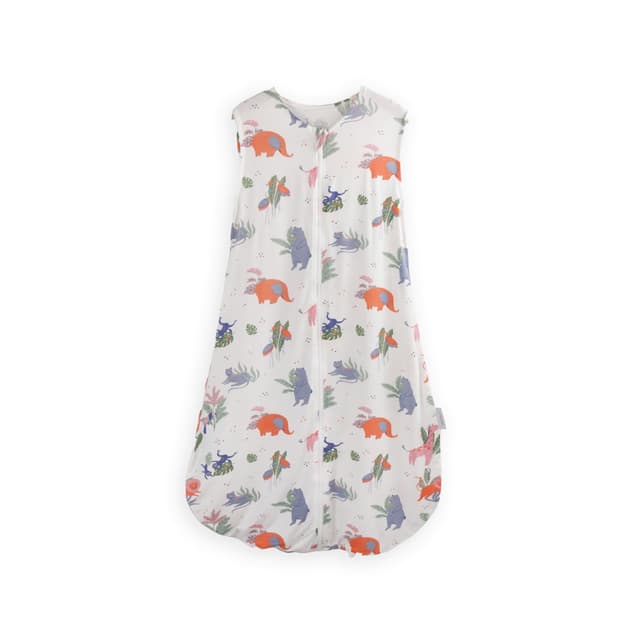
What comes next
What if she rolls but sleeps badly with her arms free?
She probably will, for a week or two, and that isn't a reason to go back. Expect several unsettled nights while she gets used to having her arms free, then a fairly sudden improvement as she finds she can get her fists to her mouth and settle herself, something the swaddle had been holding back.
If it hasn't passed after a fortnight, check other things before you blame the change: the room temperature, the last feed of the evening, and whether the sleep sack is the right size and weight for her room. The answer is almost always one of those.
Once you've stopped swaddling, the muslins still get used. Ours went on for years as nursing covers, as the cloth thrown over a hot car seat in a carpark at noon, and for mopping up everything else.
Afterwards
Sources
- The Lullaby Trust: Swaddling and slings
- American Academy of Pediatrics: A Parent's Guide to Safe Sleep
- NHS: Reducing the risk of sudden infant death syndrome
This guide is general information, written to help you understand a topic and ask better questions. It is not medical advice and does not replace your own doctor, midwife or paediatrician. Anything that worries you about your baby belongs with them.