

25 October 2026 · Veronica Chi
Business & Product Director · Mother of two
Zinc Oxide, Petroleum Jelly and Diaper Cream: Which Should You Use?
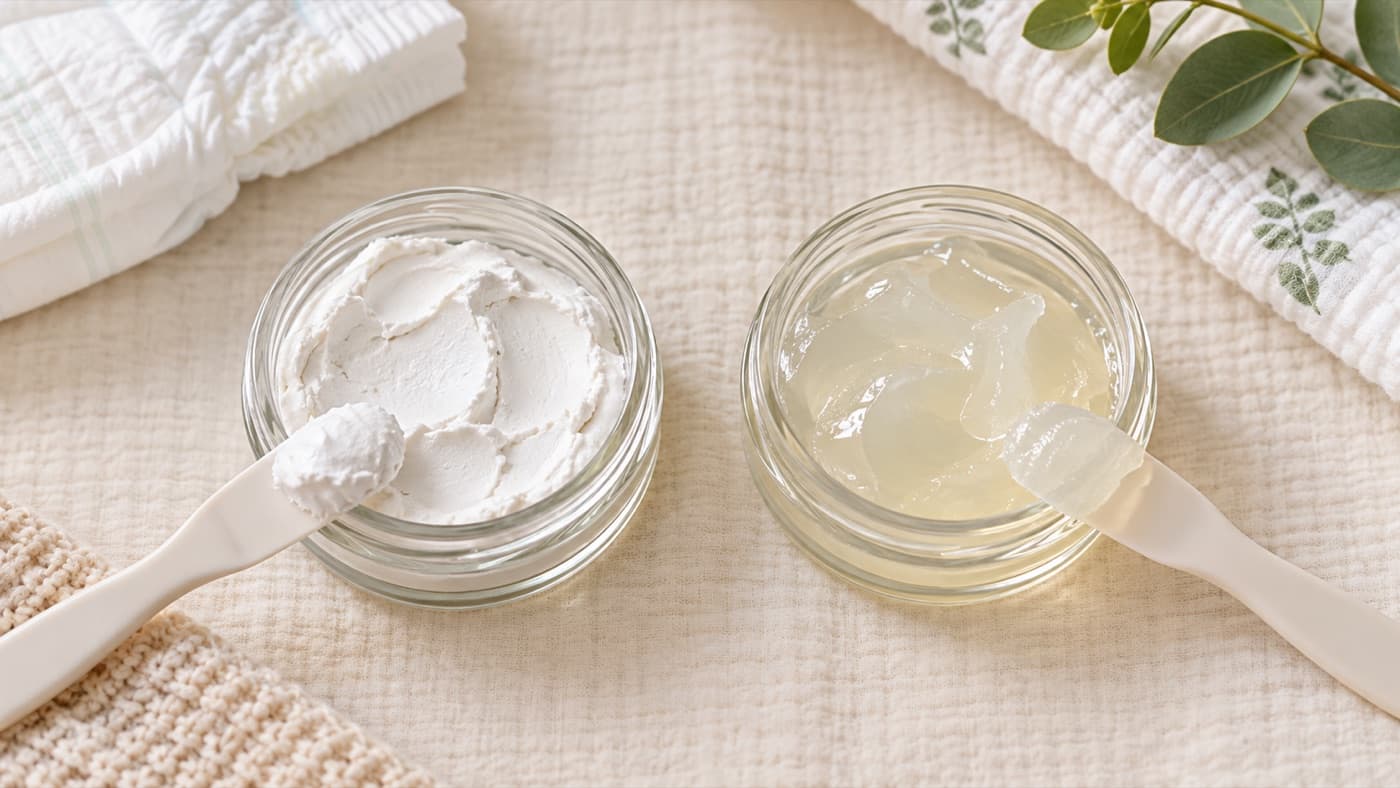
Most diaper creams do one job, which is to put a layer between the skin and whatever is in the diaper. Zinc oxide, petrolatum and dimethicone are the three barrier ingredients on most labels, and any of them is a reasonable choice for an ordinary rash. The differences that matter are the form it comes in, what else is in the tube, and whether the rash is the ordinary kind at all.
Little Rei doesn't make a cream, so there's nothing for me to sell you here. I specify the topsheet on our diapers, and the question I'm asked most often after that is what to put underneath it.
What a barrier cream does
Ordinary diaper rash is irritant dermatitis: skin softened by moisture, then irritated by urine and stool kept against it. A barrier cream doesn't change that chemistry. It lays a film over the skin that keeps the irritants off while the skin recovers, and the American Academy of Dermatology puts it third in its list, after changing the diaper promptly and cleaning gently. The evidence that one barrier beats another is thin. A 2026 meta-analysis in Cureus pooled six studies of barrier preparations and could not show a clear overall effect, with wide variation between the trials, and in the one petroleum jelly trial it included the jelly gave no significant benefit. That isn't proof that barriers are useless. It means the trials are small and unlike each other, and that frequent changes count for at least as much as what goes on afterwards.
| Ingredient | What it is | US skin protectant range | What to know |
|---|---|---|---|
| Zinc oxide | A white mineral powder suspended in a base | 1% to 25%; diaper rash pastes are also sold at 40% | Thick, opaque and slow to rub off; can stain cloth |
| Petrolatum (petroleum jelly) | A purified mixture of hydrocarbons | 30% to 100% | Water-free, so it needs no preservative; greasy; can coat cloth fibres |
| Dimethicone | A silicone | 1% to 30% | A lighter, less greasy film; no infant diaper rash trial found |
Zinc oxide, and which strength
Zinc oxide is the ingredient the American Academy of Dermatology names, and the AAP calls zinc oxide and petrolatum both good choices. The US skin protectant monograph allows zinc oxide at 1 to 25 per cent, and pastes labelled 40 per cent are sold in the US for diaper rash. I haven't found a trial that compares strengths head to head for diaper rash. Nobody seems to have run one. A 2025 review reports 5 to 10 per cent as effective for mild skin conditions generally, which isn't the same question. What a higher percentage reliably gives you is a stiffer, whiter paste that stays on wet skin longer and takes more effort to remove, and for a rash that is already sore I think that's the point of it.
Petrolatum
Petroleum jelly is the simplest product on the shelf, often 100 per cent petrolatum, with no water and therefore no preservative. DermNet notes that water-free ointments rarely cause contact allergy for that reason, and plain petrolatum is the alternative dermatologists suggest for people who turn out to be allergic to lanolin. Its weakness is that it's thinner and more slippery than a zinc paste, so it comes off more easily on a wet, wriggling baby. Reapply often.
Dimethicone
Dimethicone is a silicone, permitted at 1 to 30 per cent under the same monograph, and it is the usual base of creams sold as non-greasy. I couldn't find an infant diaper rash trial that tested it on its own, and the 2026 meta-analysis had none to include. I treat it as a reasonable barrier with less evidence behind it than zinc oxide.
Lanolin, fragrance and preservatives
Lanolin is wool wax, refined from sheep's wool, and it's a permitted skin protectant at 12.5 to 50 per cent. The American Contact Dermatitis Society named it Allergen of the Year for 2023. It rarely sensitises healthy skin, but people with chronic inflamed skin are at higher risk, perianal and genital dermatitis among them, and a patch test on healthy skin can miss the allergy. A baby with eczema and a sore bottom fits that description closely. If a lanolin cream seems to make the rash worse, stop it and use plain petrolatum.
Fragrance is the easiest thing to leave out.
The AAP says fragrance-free products are best, and the NHS and the AAD both specify wipes that are free of fragrance and alcohol. Preservatives are the less obvious problem. Any product that contains water needs one, and since that's the main difference between a cream and an ointment, the switch from a cream to an ointment is often the simplest way to take a preservative out of a baby's routine without having to read every label in the pharmacy aisle. The clearest example in children is methylisothiazolinone, a preservative once common in wet wipes: a 2014 report in Pediatrics described six children with a persistent rash on the bottom and face that had not responded to antibiotics or steroids and cleared quickly once the wipes were stopped. None of the six wore diapers, so the wipe, and not the diaper, was the cause. Essential oils fall in the same family of risks, and America's Poison Control centre advises keeping them off damaged skin altogether.
Paste, ointment or cream
| Form | What it is | Preservative | On a diaper rash |
|---|---|---|---|
| Ointment | Mostly oil, with little or no water | Not needed, so contact allergy is rare | Stays on wet skin; greasy |
| Cream | Roughly half oil and half water | Needed | Rubs in easily; more likely to sting broken skin |
| Paste | Oil and water thickened with a lot of powder, often zinc oxide | Depends on the formula | Stiff and long-lasting; the usual form for a sore rash |
On an active rash, the AAP and the AAD both say to apply a thick layer and not to scrub it all off at every change: remove only what is soiled, add more on top, and take it off fully once a day. I'd put it this way: a thin film on skin that is fine, a generous layer on skin that is already red.
The rash itself
Cloth diapers
Barrier creams and cloth diapers don't always get on. Petrolatum can coat the fibres so that they repel water instead of absorbing it, synthetic fibres such as microfibre are the worst affected, and zinc oxide can stain. Cloth diaper retailers generally advise a liner between the cream and the diaper, or a cream labelled for cloth use, and a hot wash for natural fibres. That advice comes from shops that sell the alternatives, so read it as practical experience and check your own diaper maker's care instructions.
Antifungal and steroid creams need a diagnosis
A barrier protects skin from irritants, but it doesn't treat an infection. That's the limit. Yeast is the usual reason a rash refuses to improve: the AAP describes it as bright red and shiny with sharp edges, worse in the skin folds, sometimes with small pink spots beyond the main patch, and often following a course of antibiotics. It needs an antifungal. In a 2010 randomised trial of 96 infants, pastes containing clotrimazole or nystatin both improved the rash, and clotrimazole did somewhat better. Steroids are different. DermNet accepts a mild hydrocortisone for one to two weeks on an inflamed rash, and says strong steroids should not go on a baby's bottom because of side effects such as thinning of the skin. Neither should be chosen on guesswork, since a steroid on a yeast rash can make it worse while appearing to calm it.
Natural is a marketing word
A natural ingredient isn't automatically a gentler one. Lanolin is about as natural as an ingredient gets, and it was the 2023 Allergen of the Year. Calendula belongs to the daisy family, and the European Medicines Agency's draft herbal monograph lists allergy to that family as a reason not to use it, names skin sensitisation as a known effect and does not recommend it for children under six, for lack of experience. Essential oils are plant extracts too. The question I would put to any tube is what is in it, at what strength, and whether anyone has tested it on babies.
For an ordinary rash I'd choose a fragrance-free zinc oxide paste or plain petroleum jelly on clean, dry skin. I'd avoid lanolin for a baby with eczema, and read the preservative list on anything sold as a cream rather than an ointment.
Mentioned above
Evidence
- American Academy of Pediatrics: Common diaper rashes and treatments
- American Academy of Dermatology: How to treat diaper rash
- NHS: Nappy rash
- DermNet: Napkin dermatitis
- DermNet: Topical formulations
- US Code of Federal Regulations, 21 CFR 347.10: Skin protectant active ingredients
- DailyMed: Zinc oxide 40% diaper rash skin protectant ointment, label
- Alkhamis et al. (2026), Clinical effectiveness of barrier preparations in the management of diaper dermatitis: a systematic review and meta-analysis, Cureus
- Gupta & Parasramani (2025), The role of zinc oxide in dermatitis of varied etiology: a comprehensive review, Int J Res Med Sci
- Johnson et al. (2023), Lanolin: the 2023 American Contact Dermatitis Society Allergen of the Year, Cutis
- Chang & Nakrani (2014), Six children with allergic contact dermatitis to methylisothiazolinone in wet wipes, Pediatrics
- Hoeger et al. (2010), Two antifungal pastes in infants with diaper dermatitis: a randomized controlled study, J Eur Acad Dermatol Venereol
- European Medicines Agency (2007), Draft community herbal monograph on Calendula officinalis flos
- Poison Control (US): Essential oils, poisonous when misused
- Kinder Cloth Diaper Co.: Cloth diaper safe diaper cream (retailer guide)
This guide is general information, written to help you understand a topic and ask better questions. It is not medical advice and does not replace your own doctor, midwife or paediatrician. Anything that worries you about your baby belongs with them.