

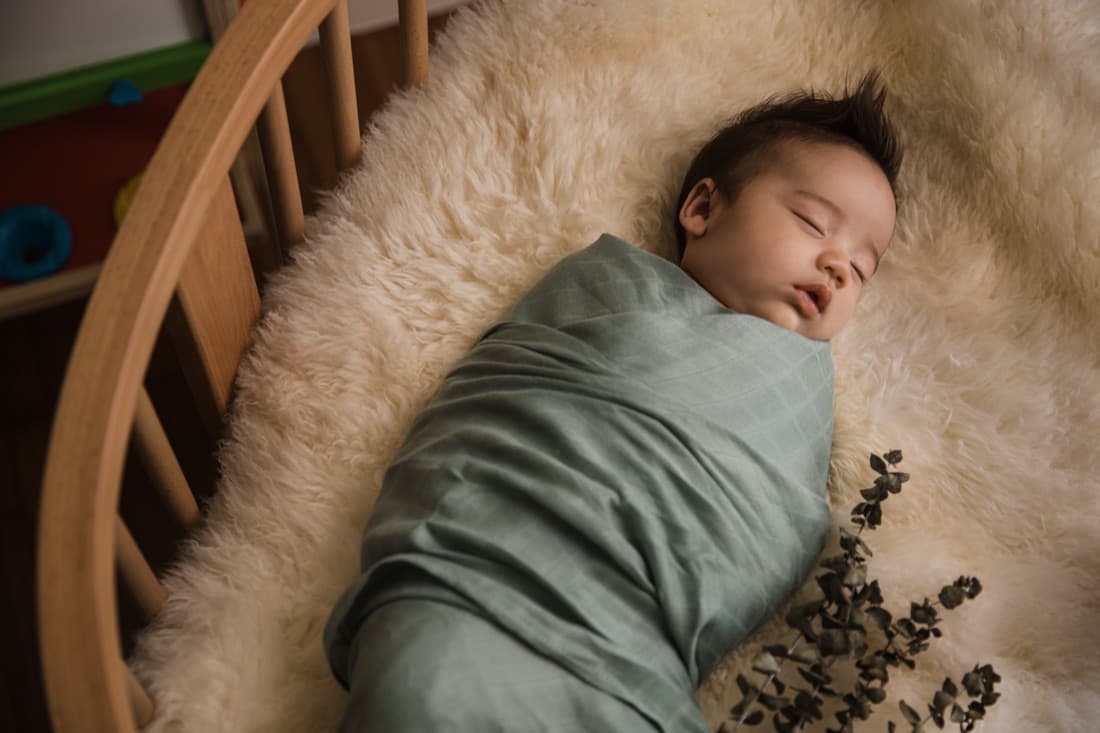
I was raised on this, and I mean raised: my grandmother in Thessaloniki believed a full moon disturbed children, my mother believed it after her, and I wouldn't swear on anything that I didn't half believe it myself through five children and more broken nights than I could count, because when you're up at three in the morning for the fourth time you'll take any explanation that is offered, and the moon is right there in the window offering itself.
It has been studied properly, and it isn't true. I'm not being contrary for the pleasure of it, at my age. The belief has a cost, which I'll come to.
The biggest study I know of looked at nearly six thousand children across twelve countries, tracked their sleep and their activity and their mood against the lunar cycle for more than two years, and did it with sensors on the wrist instead of with tired parents' memories, which counts for more than it sounds.
What it found was that children slept about five minutes less on average around the full moon, which is roughly one per cent of a night, and no real difference at all in how active they were or how they behaved, and the authors were direct about what that means, which is that the effect is negligible and nothing like what parents report, me included.
Five minutes. Not a wakeful night, not a fractious week, five minutes on average, and well inside the range that a warm room or a late dinner or a visiting cousin would produce in any household on any night of the month.
The adult studies point the same way, and there's a pattern to them that I've come to recognise in a lot of things: an early small study suggested a lunar effect on sleep, it got a great deal of attention, and then when much larger groups were examined the effect didn't reappear, which is the usual life cycle of a result that was too pleasing to be true.
Then why is the belief so strong?
Because our attention isn't neutral — I include my own in that, having spent forty years being an unreliable witness on this exact question. On a difficult night you look for a reason, and the moon is the only explanation you can see from a bedroom window, so if it happens to be full the night gets filed under the moon, and if it's full and everybody sleeps through then nobody files anything at all, because a quiet night leaves no record and nobody stands at the window at seven in the morning thinking, well, that was a full moon and nothing happened. Over five children that produces a very convincing pile of evidence with the contradicting half thrown away. Then the belief gets shared, which is what makes it strong. Somebody at a lunch says it was a full moon last night, and three people agree that their children were dreadful, and the story is confirmed by a whole table of people all remembering selectively together, and this, I've come to think, is how folk knowledge manages to survive being wrong for several centuries at a stretch. My mother's generation did it with the moon and mine did it with teething, and I'm sure my daughters' generation has its own. There's a professional version too. Nurses and midwives report it, and I've heard it from a very experienced midwife in Hong Kong who I'd trust with anything, but studies of hospital admissions and of birth rates have looked for it repeatedly and not found it, and believing something confidently while being mistaken about it are perfectly compatible, as I can tell you from experience, and that applies to experienced people every bit as much as to the rest of us.
What disturbs a night
Whether there is any plausible mechanism at all
One, and it's small and it isn't mysterious.
Light. A full moon is brighter than no moon, and light does affect sleep, that much is real, but a full moon delivers a small fraction of what a single street lamp gives off, and any room with a curtain in it has already removed far more light than the moon was ever going to add, so in a flat with any blackout at all the moon is simply not reaching your child, whatever it's doing to the sea.
The tidal explanation comes up a great deal, usually from somebody's husband, and it doesn't work: tides are produced by the difference in the moon's pull across the whole width of an ocean, and a sleeping child, however much she has eaten, isn't wide enough for that difference to exist in any measurable form. The moon pulls exactly as hard at new moon as at full. Only the light changes.
So what's behind a run of bad nights
Something ordinary, almost always, and the list is short enough to work through in the time it takes the kettle to boil.
- Overtiredness accumulated across several days, which is the commonest cause by a distance and the one that compounds.
- A developmental leap, rolling, crawling, standing, first words, which reliably disturbs sleep for a week or two and then settles.
- Teething, particularly the molars, which nobody warns you about and which take days.
- Illness arriving before it's visible. A great many bad nights are explained by a temperature the following afternoon.
- A room that has become too warm, which in this part of the world is the most overlooked cause.
- A change in routine, a new carer, a house guest, a return to work. Small children register these long before they can mention them.
- A nap dropped or shortened, which shows up at two in the morning and not at bedtime.
Any of those explains a difficult week a great deal better than an object a quarter of a million miles away, and every one of them is something you can do something about, which the moon isn't.
Whether it matters what parents believe
I think it does, and it's the only reason I'd bother writing this at all, because if it were a harmless story I'd leave people to it, the way I leave my husband to his views on football.
A parent who puts a bad week down to the moon has an explanation that demands nothing of them, and I understand the appeal of that at four in the morning better than most, but it's also a reason to stop looking, and so the actual cause, the missed nap or the warm room or the tooth that's coming through, goes unaddressed and produces another bad week, and then another, while everyone waits for the moon to move on.
There's a second cost, which is that expecting trouble shapes what you notice. A parent who knows it's a full moon watches for disruption and duly finds some, and may go in more readily than usual and wake a child who was, left alone, about to resettle herself, which I did more than once and only understood later.
What deserves doing instead
Look at the last three days, and not at the sky.
Check the naps, check the room temperature, check whether anything changed in the household, a visitor, a new nursery, a parent working late, and check whether she's working on something new with her body, because rolling and crawling and pulling up all wreck sleep for a week. Then bring bedtime forward for a few nights, since overtiredness is the likeliest answer of all and an earlier start is the most effective correction there is, however much it feels like the wrong direction.
Keep the room dark, which deals with the moon and every street lamp on the road at the same time, for the price of a curtain.
I've let go of a good many things I was taught, some of them reluctantly, and this is one I'm glad to be rid of, because it was never really a comfort so much as a way of not looking, and I'd rather look.
The questions I get at lunch
Does the full moon affect baby sleep?
Barely. The largest study in children, covering more than 5,800 children across five continents, found about five minutes less sleep around the full moon and no real change in activity. That's undetectable in an individual child.
Why do so many parents believe in the full moon effect?
Confirmation bias. A bad night that coincides with a full moon gets remembered and attributed to it, while bad nights at other times are attributed to teething, illness or a busy day. Nobody counts the good nights that fall on a full moon.
Does the moon affect when babies are born?
Studies of birth rates and lunar phase have consistently found no relationship, despite a widespread belief among maternity staff that full moons are busier.
Can moonlight really disturb my child's sleep?
Only if it reaches them. Light is the one plausible mechanism, and a modern bedroom with curtains blocks it. A streetlight is brighter than a full moon. If moonlight falls on the bed, a blackout blind solves it.
What causes a run of bad nights?
Developmental leaps, nap transitions, separation anxiety, teething, an oncoming illness, a room that is too warm, or a disrupted schedule. Persistent disruption, especially with snoring, breathing pauses or feeding difficulty, should be discussed with a doctor.
What I read before I wrote
This guide is general information, written to help you understand a topic and ask better questions. It is not medical advice and does not replace your own doctor, midwife or paediatrician. Anything that worries you about your baby belongs with them.