

24 February 2026 · Veronica Chi
Business & Product Director · Mother of two
How to Wear a Newborn in a Baby Carrier
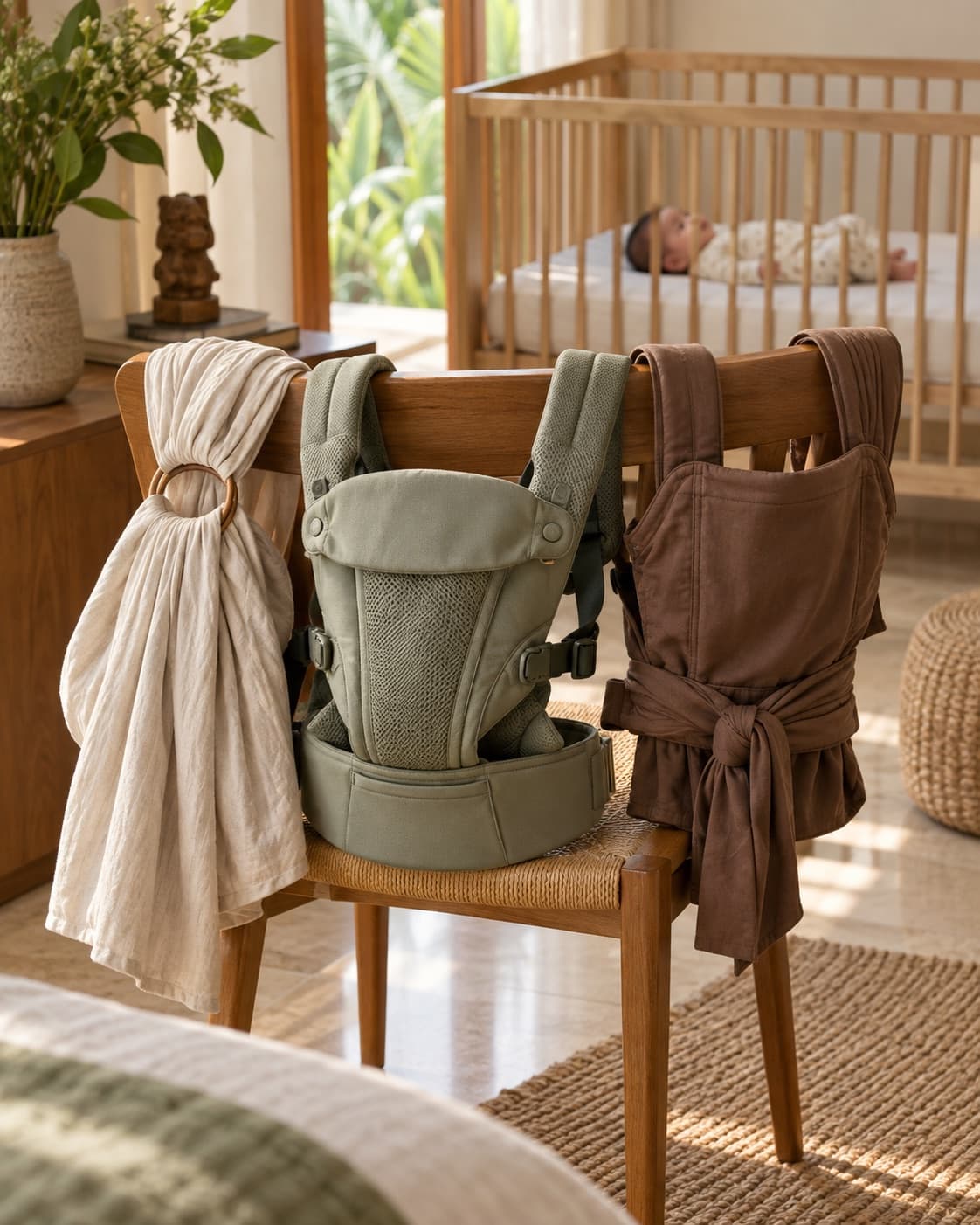
I've carried two babies, and what I'd most like to change is that almost nobody is shown how to do this in person. There is one rule: a newborn in a carrier is safe when her airway is open and stays open. Every check, position and mistake below comes back to that.
It matters because a baby under about four months cannot lift her head off her own chest, cannot turn away from fabric across her face, and cannot tell you either has happened. She can't fix it herself, so you have to.
TICKS: learn it by heart
Five checks that take ten seconds. Learn them well enough to run without thinking, because you'll be doing them in a lift, in a queue, and with one hand full of shopping.
- Tight. The carrier should hold the baby firmly against you, with no slack that lets them slump into a curl. A loose carry is the kind that blocks an airway.
- In view at all times. You should see their face by glancing down, without moving any fabric.
- Close enough to kiss. The top of their head should be at your chin, so you can tip your head and kiss it.
- Keep chin off the chest. Leave at least a finger's width under the chin. When a newborn's chin presses on her chest, her airway can close.
- Supported back. Their back should be held in its natural gentle curve, tummy and chest against you, not slumped and not pulled straight.
Check all five every time you put her in, and again whenever you've been walking for a while. That habit is most of what keeps her safe.
| Means | |
|---|---|
| Tight | The carrier holds baby close, with no slack to slump into |
| In view at all times | You can see her face by glancing down |
| Close enough to kiss | Her head is at your chin, not on your chest |
| Keep chin off the chest | A finger's width under the chin, so the airway stays open |
| Supported back | Her back is in its natural curve, tummy against you |
The position itself
Upright, chest to chest, high on you, and nothing near her face. The details below matter, but that sentence covers most of it.
- Upright. Never lying flat, or curled chin-to-chest in a bag-style or cradle position. That curled position is the one most often behind blocked airways in slings.
- Chest to chest, facing in. Newborns face inward only.
- High on your body, above your waist. A carrier worn low is uncomfortable and lets the baby slump.
- Knees higher than bottom, thighs supported to the knee, legs in a spread squat. In the first weeks the legs are often tucked up froglike inside the carrier instead of through the leg holes, which is fine if the carrier is designed for it.
- Face turned to the side, cheek against you, nose and mouth completely clear of fabric and of your body.
- Nothing over their face. No muslin, no blanket, no coat flap.
The rest of babywearing
Getting them in and out
Putting her in and taking her out is where most of the risk is, and it's the part nobody shows you properly in a shop.
- Put the carrier on first and adjust it to your body before the baby goes anywhere near it.
- Support the head and neck with one hand throughout for a young newborn.
- Do it over a bed or a sofa the first several times, and with someone else present if you can.
- Tighten from the bottom up: the panel, then the straps, then check the waistband, so the fabric supports her without squashing her.
- Check TICKS after tightening, not before.
- To take them out, support the head, loosen gradually, and lift the baby out towards you. Don't lift the carrier off around them.
The mistakes that matter
These are the mistakes with real consequences, roughly in order of how often they happen. The order is my own estimate; I'm not sure anyone has counted.
- Too loose. Far more common than too tight, and far more dangerous. A baby who can slump ends up with her chin on her chest.
- Worn too low, so the head is at chest height and out of sight.
- Fabric over the face for warmth, sun or privacy. This is the most common serious error.
- A newborn insert used incorrectly, or a carrier used without one when it requires it.
- Wearing a coat over the top of the baby, which restricts airflow and hides them. Use a babywearing cover designed to leave the face clear, or a coat worn open.
- Bending forward from the waist. Bend at the knees, with a hand supporting the baby.
Which carriers suit a newborn
There's no single best one. Four kinds work, and two kinds should be avoided.
- Stretchy wrap. Excellent for the first months, snug and adjustable, and you can tie it before the baby goes in. Outgrown fairly quickly.
- Ring sling. Fast, one-shouldered, good for short carries and discreet feeding. Takes a little practice to thread and tighten evenly.
- Soft structured carrier with a proper newborn setting or insert. The easiest to put on, but check that it narrows enough for a newborn. A panel that's too big is the usual problem.
- Woven wrap. The most adjustable and the hardest to learn, but excellent once you have it.
- What to avoid: bag-style slings that hold a baby lying curled and low, and any carrier that supports only the crotch with the legs hanging straight.
What not to do while wearing her
These look obvious written down. Each one happens because a carrier makes you feel as though both hands are free. They are not.
- Cooking at a hot hob, carrying hot drinks, or anything involving hot liquid.
- Travelling in a vehicle. A carrier is never a substitute for a car seat, and a baby should never be worn while seated in a moving car.
- Cycling, running or any activity with a fall risk.
- Drinking alcohol, or wearing a baby when you're drowsy or not fully alert.
- Reclining or lying down with a baby still in the carrier, or falling asleep yourself while wearing them.
If anything looks wrong
Take her out and start again. If you're unsure about a carry, taking her out is always the right choice.
If she looks floppy, grey or blue, is breathing noisily or with obvious effort, or can't be roused: take her out immediately, hold her upright with the airway open, and call emergency services.
Sources
- The Lullaby Trust: Swaddling and slings
- NHS. Reducing the risk of sudden infant death syndrome
- International Hip Dysplasia Institute: Baby carriers, seats and other equipment
This guide is general information, written to help you understand a topic and ask better questions. It is not medical advice and does not replace your own doctor, midwife or paediatrician. Anything that worries you about your baby belongs with them.