

24 February 2026 · Roshni Mahtani Cheung
Cofounder, Little Rei · Mother of one
When Can You Start Babywearing?
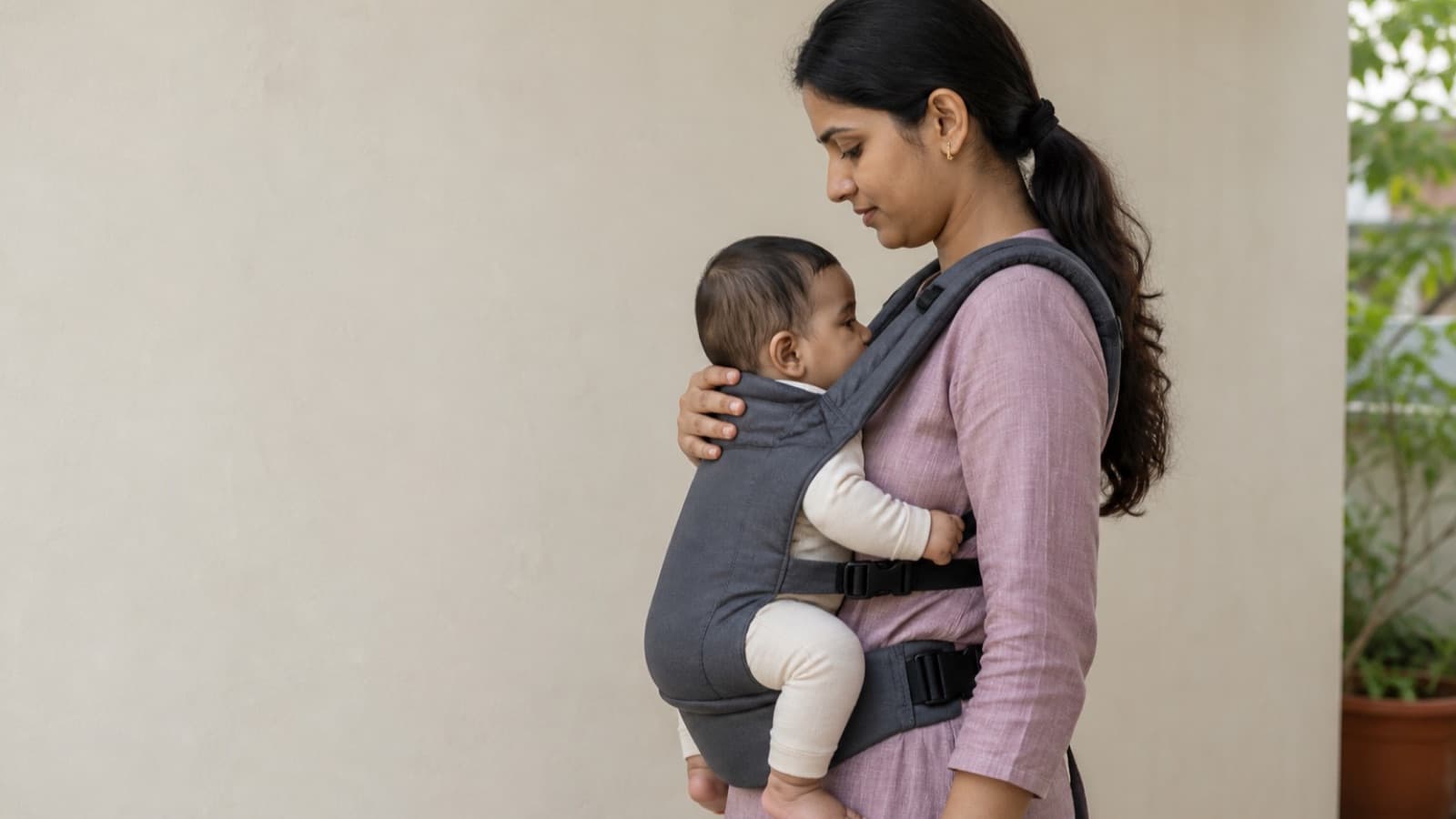
You can start from birth, with the right carrier and the right position. Most people are surprised there's no waiting period.
There's no minimum age or weight for babywearing as a whole. What changes as she grows is which carrier suits, which positions are safe, and how much of the work her own body can do.
What changes things is her own development, in two steps: first head and neck control, then control of her trunk. Everything else follows from those two.
What has to be true before the first carry
There are five conditions. All five have to be true before the first carry, and if one isn't, the carry waits.
- The carrier fits the baby, not just the adult. Many structured carriers have a minimum weight, commonly around 3.2kg, or require an insert for a newborn.
- The baby is upright, chest to chest, high enough on you that you could kiss the top of their head without straining.
- The airway is clear. A newborn can't lift their head off their own chest, so nothing may push their chin down and nothing may cover their face.
- Their back is supported in a gentle curve and never pulled straight, and their knees sit higher than their bottom.
- You can see their face without moving fabric aside, at all times.
If one of those isn't true, the problem is almost never that your baby is too small. Usually this carrier just isn't right for her yet, and that's much easier to fix.
Stage by stage
Go by those two milestones, head control and then trunk control, more than by her weight, her age in weeks or what the box says.
| Stage | Carrier | Positions |
|---|---|---|
| Newborn to ~4 months | Stretchy wrap, ring sling, soft carrier with newborn setting | Upright, chest to chest, inward facing only |
| 4-6 months | Woven wrap, soft structured carrier | Inward facing; front-outward for short spells once neck control is solid |
| 6 months to sitting | Structured carrier, woven wrap | Inward, hip carry once they sit steadily |
| Sitting unaided onward | Structured carrier, onbuhimo, woven wrap | Back carry becomes appropriate; check your carrier's guidance |
| Toddler | Toddler-size structured carrier | Back carry mostly; short front carries still fine |
Once you start
The hip question
A baby's hip joints are still forming through the first year, and the way she's held affects how they form. The healthy position for her hips is the one she takes naturally when you pick her up: legs in a spread squat, knees higher than her bottom, thighs supported all the way to the knee. A carrier that supports only the crotch and lets her legs hang straight down holds the joint in the worst position. So this is the first thing I'd check when choosing a carrier, and it's easy to see, because the fabric should reach from knee to knee and not just across the nappy. The International Hip Dysplasia Institute calls this the M-position: thighs spread around you, knees bent and a little higher than her bottom, each thigh supported along its whole length, and no weight hanging from the crotch. Scans have found that wide-seated carriers hold the hip in roughly the same position as a Pavlik harness, the brace used to treat hip dysplasia. A carrier isn't a treatment and should never be sold as one, but it does show that the difference between a wide seat and a narrow one is real and not marketing.
Facing outward
Not until her neck control is fully there, around four to six months, and then only for short spells. There are two reasons. A baby facing out can't turn away when there's too much going on, so she can get overwhelmed with no way to show you. And the position usually supports the hips less well, because her legs hang down instead of settling into a spread squat. Twenty minutes at a time is about the limit. Turn her back in when she gets tired.
Back carries
Once she can sit without help, and following your carrier's instructions, because some carriers allow back carries earlier and some later. For the first several tries, practise over a bed or with someone standing by to help. Learning it pays off: a back carry is far more comfortable over long periods, and it keeps a curious older baby out of whatever your hands are doing.
When to take extra care
Five cases where the usual advice needs adjusting: three about the baby, two about you.
- Premature or low birth weight babies. Skin-to-skin carrying is actively beneficial and often encouraged, but take specific guidance from your neonatal team on positioning and timing.
- Babies with a cold or any breathing difficulty, whose airway is more easily blocked in a carrier. Check more often and keep carries short.
- Babies with low muscle tone or a diagnosed hip condition, where the carrier choice should be discussed with your paediatric team.
- After a caesarean, when the scar can make a front carry uncomfortable for several weeks. A ring sling worn high, or waiting until you've healed, usually works better than pushing through.
- Pelvic floor and back recovery after any birth. Build up carrying time gradually, and don't start with a long walk.
When to stop
There's no fixed end. Most families stop somewhere between two and four, usually because the child gets heavy and very rarely because the child wants to. The real limits are your carrier's maximum weight and your own back. A toddler carrier that spreads the weight across your hips and off your shoulders lets you keep going much longer, and short back carries still work long after daily carrying has stopped.
I wore her everywhere
To work. Into meetings. On flights, on trips, around the house, in front of the television. And while cooking, which I'll come back to. I don't know how many hours a day it was, but it was most of them.

Asleep in the carrier, which for about eighteen months was the only place other than a person where she reliably slept.
For most of eighteen months the carrier was simply how I did everything. Shan slept in it, and she slept better there than anywhere except on a person. Given how badly she slept everywhere else, that made it the best thing I owned.
It also taught me things about her I didn't know I was learning. You notice a lot with a baby against your body that you can't see from across a room, and years later that mattered more than I could have guessed at the time.

Still going at toddler stage. A carrier that puts the weight through your hips, and not your shoulders, is what makes this last.
The one I'd take back is the cooking. A carrier puts a baby's head at about hob height, and it gives you a strong feeling that both hands are free, which they aren't. Our own list of things never to do with a baby in a carrier includes anything with hot liquid. It's the rule I broke most often, because it was convenient and I hadn't thought about it at all.
Cook while somebody else holds her, or make a simpler meal. Those are the two safe options, and for months I picked a third one that wasn't.
Apart from getting your hands back, carried babies cry less on average, skin-to-skin contact helps with feeding and settling, and a carrier is often the only way to leave the flat with a newborn and a toddler at the same time.
In a small flat, when your four-month-old will only sleep on you, a carrier is what lets you make lunch as well, and at that stage that's a big deal.
This guide is general information, written to help you understand a topic and ask better questions. It is not medical advice and does not replace your own doctor, midwife or paediatrician. Anything that worries you about your baby belongs with them.