

Self-care in pregnancy has been fairly thoroughly colonized by the spa industry, which is a shame, because the things that make a pregnancy easier are mostly unglamorous and mostly free.
I've been pregnant four times and I trained as a physiotherapist, so the movement and positioning parts of this are inside my own field and I'll say so where they are. Everything touching symptoms, medication or your particular pregnancy belongs with your midwife, obstetrician or doctor, who knows things about you that I don't.
What changes in each trimester
The demands shift enough that one routine won't carry you through all three, and it helps enormously to stop expecting it to. In the first trimester the dominant problems are nausea and a fatigue quite unlike ordinary tiredness. Eat small and often, keep something plain within reach of the bed, and sleep whenever the opportunity presents itself, because fighting that fatigue doesn't work and costs you more than giving in to it. The second trimester is the most functional stretch you'll get. Energy returns, the bump isn't yet limiting, and it's the right window for anything that needs doing. Build the movement habit now, book the appointments, and get the practical things ready while you have the capacity for them.
The third brings weight, heat, breathlessness, reflux and increasingly broken sleep. Manage the heat, shorten your ambitions for the day, and put your energy into the sleep positions that let you stay asleep.
Sleeping while pregnant
From the second half of pregnancy, guidance in most countries is to settle to sleep on your side, because lying flat on your back can compress the vena cava and reduce blood flow. Waking up on your back isn't a crisis. Turn over, go back to sleep, and ask your own care team what applies to you.
The pillow between the knees is the most effective change most people make, and it's a straightforwardly biomechanical one: it keeps the hips and lower back aligned through the night. A second pillow under the bump takes the drag off the abdominal muscles in the third trimester, which is the other change I recommend to almost everybody. Both of those are inside my training and I'll stand behind them.
Propping the upper body slightly helps with reflux as the stomach gets compressed. Keep the room cooler than you think you need, because pregnancy raises your core temperature and metabolic rate and a room that was comfortable before will often be too warm now. Choose breathable bedding and sleepwear, because fabrics that move moisture away from the skin make night sweats far less disruptive than dense synthetics do.
Elsewhere in pregnancy
How much to move
Most guidance for uncomplicated pregnancies suggests around 150 minutes of moderate activity a week, spread across the week. Walking, swimming, stationary cycling, prenatal yoga and sensible strength work all count.
Swimming is particularly wonderful late on, because the water takes the weight off your joints and helps with swelling, and it's the thing I recommend most often to pregnant patients and friends. If you exercised before pregnancy you can usually continue in a modified form. If you didn't, this isn't the moment to take up anything strenuous, and there's no shame at all in walking being the whole plan. I think walking was my whole plan with Melissa, since I can't remember doing anything else.
The test most care teams use is the talk test: if you can hold a conversation while you move, the intensity is about right. Stop and seek advice for chest pain, calf pain or swelling, dizziness, contractions, fluid loss or bleeding. Clear any exercise plan with your own team, particularly if you have a condition or a complication.
Skin, and heat
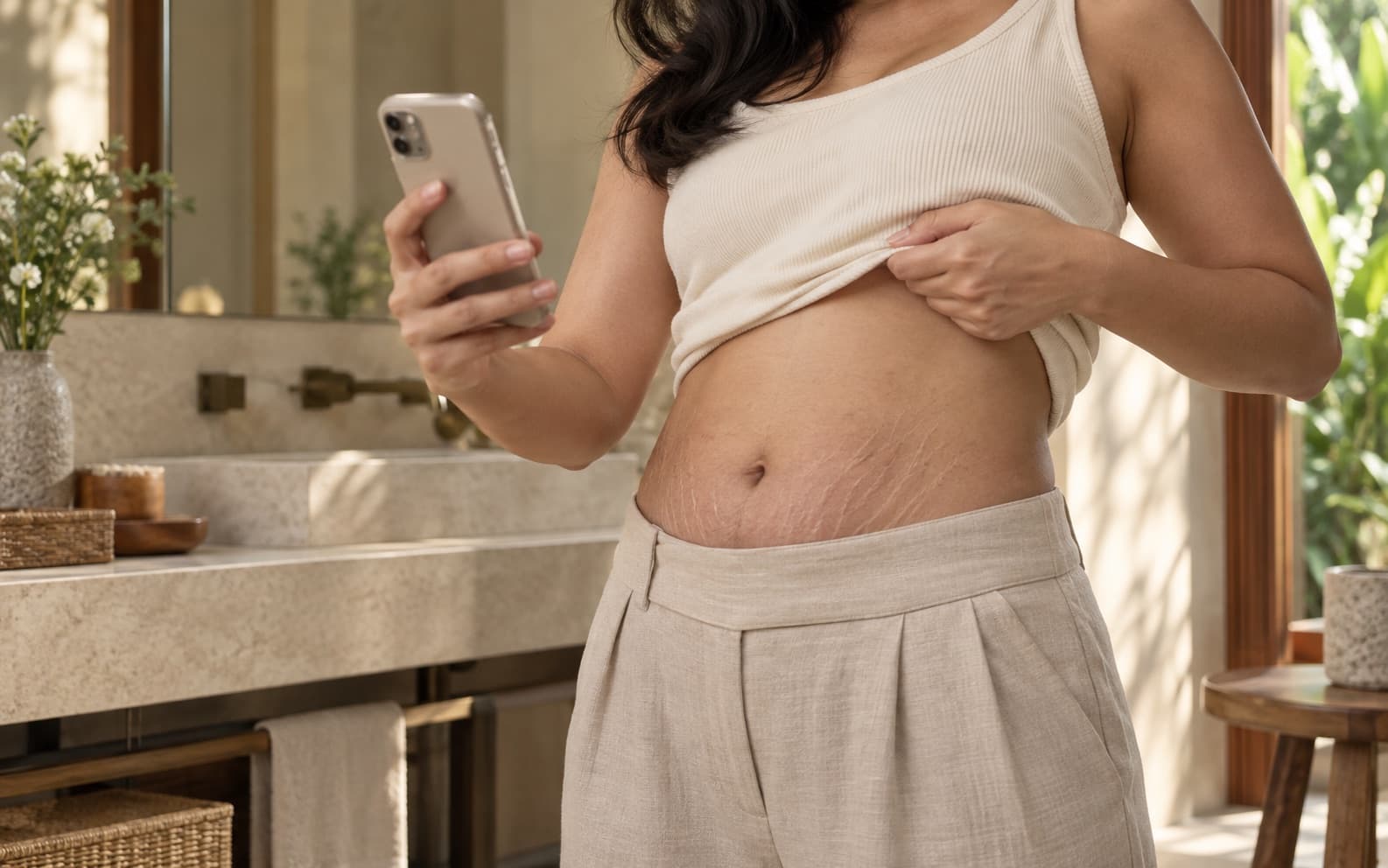
Pregnancy skin changes are mostly hormonal and mostly temporary: darker patches, a line down the abdomen, more sun sensitivity, and itching as the skin stretches. Sunscreen helps with the pigmentation changes and a plain fragrance-free moisturizer helps with the itch.
No cream reliably prevents stretch marks, because genetics and the rate of stretching dominate, so treat that entire product category with a warm and friendly skepticism. Your skin is doing something remarkable and it doesn't need to be perfect while it does it.
Heat gets its own paragraph, and living in Bangkok I've thought about it a great deal. Pregnancy raises your baseline temperature and increases blood volume, so you'll overheat sooner than you used to. Deliberate prolonged overheating, hot tubs, saunas, very hot baths, is advised against, particularly early on.
What works practically is loose single layers in breathable fabric, cool water on the wrists and the back of the neck, movement scheduled for the coolest part of the day, and drinking steadily across the day. Ordinary ankle swelling is expected. Persistent swelling in the hands and face is a different matter and should be reported.
Looking after the mental load
Pregnancy generates an enormous quantity of invisible administration, appointments, decisions, forms, logistics and other people's opinions, and almost all of it falls on the pregnant person. Anxiety in pregnancy is common, under-discussed and absolutely not a character flaw.
| Sign | Why |
|---|---|
| Any change or reduction in movements | Checked immediately, at any hour |
| Bleeding or fluid loss | Needs assessment straight away |
| Severe headache with visual changes | Points to pre-eclampsia |
| Sudden swelling of face or hands | Points to pre-eclampsia |
| Severe abdominal pain | Needs assessment |
| Fever | Needs assessment |
Write the load down and hand pieces of it away, because a task nobody else knows about can't be shared. Set a policy on advice, since "we're following our midwife's guidance" ends most unsolicited conversations kindly and without a fight. Limit the late-night searching, which reliably makes everything worse and very seldom produces anything helpful.
Protect one thing in your life that isn't about the pregnancy. Tell your care team about persistent anxiety or low mood, because antenatal depression is real, common and treatable, and treating it now is far better than waiting until afterward.
When to stop managing it at home
Some things aren't self-care problems. Contact your midwife, doctor or maternity unit straight away for vaginal bleeding, fluid loss, severe or persistent abdominal pain, a severe headache with visual disturbance, sudden swelling of the face or hands, a fever, painful or reduced urination, or any reduction or change in your baby's movements once you've started feeling them.
Reduced movement should always be checked immediately, at any hour. It's never a nuisance and nobody will think you're overreacting.
Everything else here is an attempt to make an unusually demanding nine months more comfortable. Please don't read it as a standard to live up to. Some weeks the entire self-care plan is going to bed early, and that's a complete and excellent answer.
What the research says
This guide is general information, written to help you understand a topic and ask better questions. It is not medical advice and does not replace your own doctor, midwife or paediatrician. Anything that worries you about your baby belongs with them.