

27 January 2026 · Maia Hillsborrow
Marketing Director · Mother of five
What Are the Best First Foods for Babies?
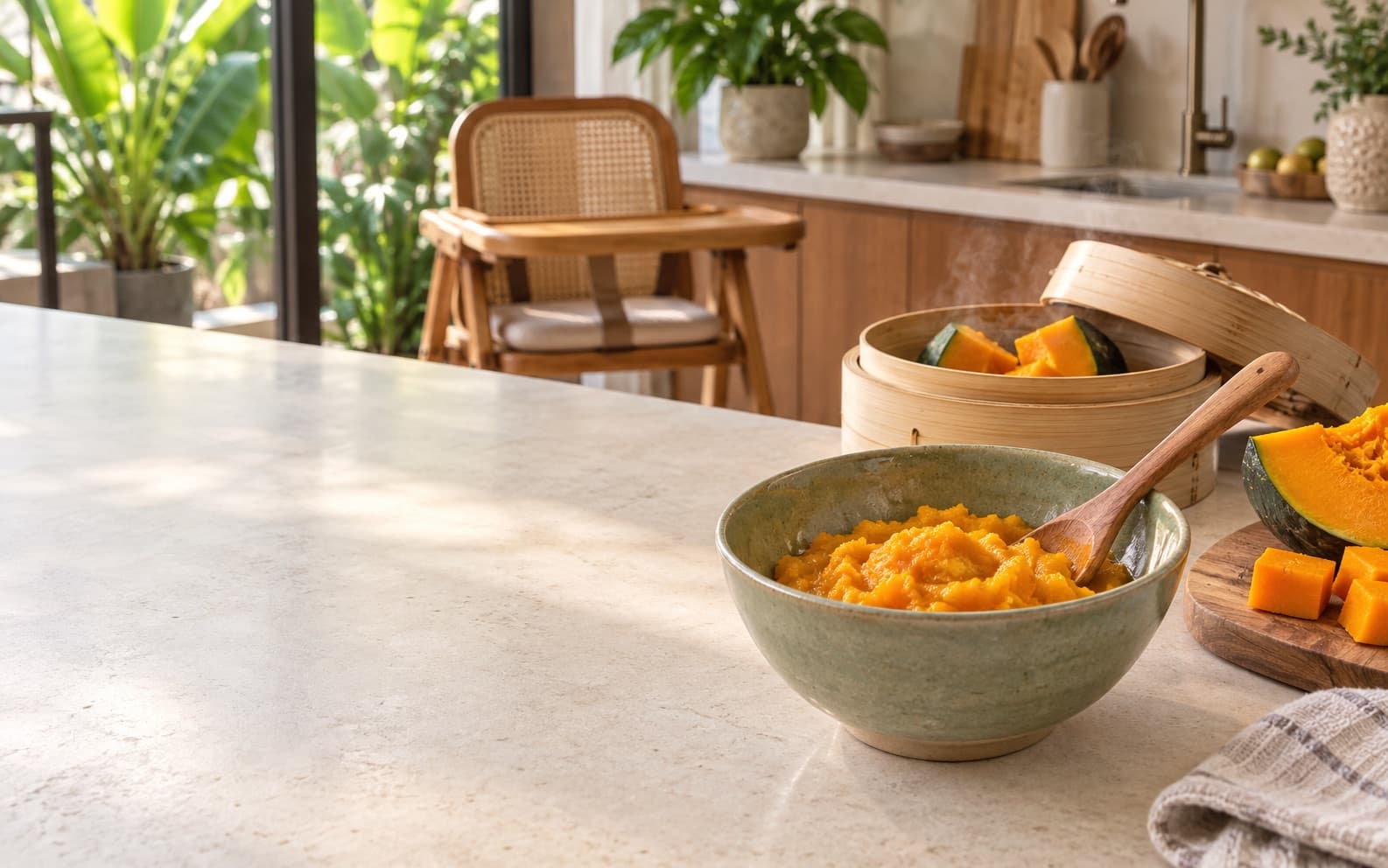
The question people ask is which food to start with. The better question is which nutrients a six-month-old needs from food, because the answer to that is narrow and specific and it points straight at what should be on the tray.
Vegetables first, and the bitter ones
There's a window at the start where a baby will accept almost anything, and it closes.
Before around eight or nine months she has no established preferences and no suspicion of the unfamiliar. Offer broccoli, spinach, zucchini, cauliflower and green beans in those first weeks and they're simply what food tastes like. Start instead with sweet potato, carrot, apple and pear, all pleasant and all sweet, and the bitter vegetables arrive later as a contrast, after she's already learned to prefer sweet.
It's one of the few times in infant feeding when timing really helps, and it costs nothing. Fruit isn't going anywhere. It'll still be sweet in a month.
Iron is the real priority
This is the part most first-food lists get wrong, and it's the thing I'd put at the top if I were rewriting them.
A baby is born with iron stores that run down at around six months, and breast milk is low in iron. From six months, iron has to come from food, and requirements per kilo at this age are higher than an adult man's. Iron deficiency in the first two years affects development in ways that aren't reliably reversible, so this outranks almost everything else.
- Meat, poultry and fish, which have the form of iron the body absorbs most easily. Puréed, minced, or as a soft strip to gnaw.
- Egg, well cooked, which is also a first-rate early allergen introduction.
- Lentils, beans and chickpeas, soft-cooked and mashed.
- Iron-fortified infant cereal, which is a reasonable vehicle and not a requirement.
- Dark green vegetables and tofu.
- Serve any of these with something containing vitamin C, like a little fruit, tomato or pepper, which helps the body absorb the iron in plant foods.
Keep cow's milk out of the cup until twelve months. In food it's fine from six months. As a drink it's low in iron and actively interferes with absorbing it.
| Stage | Form | Example |
|---|---|---|
| First weeks | Soft strips the length of an adult finger | Steamed carrot baton, roasted zucchini strip |
| First weeks (purée) | Smooth, thick enough to stay on a spoon | Blended broccoli with a little milk |
| From ~8 months | Smaller pieces as the pincer grip arrives | Pea-sized soft cubes, flaked fish |
| From ~10 months | Most family food, adapted | Unsalted portions of the household meal |
Allergens: the advice reversed
Introduce the common allergens early, from around six months, and keep them in the diet regularly once introduced. Delaying them raises the risk of allergy, which is a reversal of the advice most of our own mothers were given. Nobody seems sure how much the exact week matters, me included.
This came out of the LEAP trial, published in 2015, which followed infants at high risk of peanut allergy and found that regular early peanut consumption cut the rate of peanut allergy by roughly 80 percent compared with avoidance. That single result reversed a decade of advice to delay, and the guidance in most countries followed.
- The main ones are peanut, egg, cow's milk, wheat, soy, tree nuts, sesame, fish and shellfish.
- Introduce one at a time, a small amount, earlier in the day so you have hours of daylight to watch.
- Never whole nuts, which are a choking hazard until at least four. Smooth nut butter thinned with warm water or milk, or ground nuts stirred into something.
- Keep it in the diet. Regular exposure is what maintains tolerance, so roughly twice a week once introduced. Introducing peanut once and never again doesn't do the job.
- Mild reactions, a few hives around the mouth, some redness, mean stop, note it, and speak to your doctor before offering it again.
- Swelling of the face or lips, difficulty breathing, vomiting with paleness or floppiness is anaphylaxis and needs emergency care immediately.
One important exception. If your baby has severe eczema or an existing food allergy, she's in the higher-risk group and this should be planned with a doctor, possibly with testing first. Holly's eczema was significant enough that we did exactly that, and I wouldn't have wanted to improvise it at the kitchen table.
The rest of the weaning set
How to prepare it
Soft enough to squash between your thumb and finger, and that test applies whatever form you're offering.
For purées, start smooth and thicken over two or three weeks. Don't stay smooth for months, which is the commonest mistake and makes the move to texture much harder later. For finger foods, cut into finger-length strips so she can hold one in her fist with some sticking out above it, since a six-month-old can't yet open her hand to release something into her mouth.
Cook without salt and without sugar. Steam or roast in preference to boiling, which keeps more of the nutrients and much more of the flavor.
What to leave out in the first year
A short list, and the first two are absolute.
- Honey, in any form, cooked or raw, before twelve months. Infant botulism is rare and serious.
- Whole nuts, whole grapes, cherry tomatoes, popcorn, hard raw carrot or apple, and any hard round object that hasn't been quartered lengthwise.
- Salt. Under one year the limit is less than 1g a day, which most adult food will exceed in a single serving. No stock cubes, no soy sauce, no cured meat.
- Added sugar, which is unnecessary and shapes preference.
- Cow's milk as a drink, though in food and as yogurt or cheese it is fine from six months.
- Undercooked egg, unless it has a national safety mark that permits it.
- Shark, swordfish and marlin, for mercury, and rice drinks before five years, for arsenic.
Flavor is a skill, not a preference
The best idea I've carried through five children is that accepting a new food is something a child learns.
It takes somewhere between ten and fifteen encounters before an unfamiliar food becomes ordinary, and most parents stop at three. Encounters count even when nothing is swallowed: seeing it, touching it, licking it and putting it back are all part of the process.
Offer variety early, offer it repeatedly, offer it without any pressure at all, and eat the same thing yourself where you can. That's the entire method, and it works on every child I've had, including the two who currently claim to hate vegetables.
The evidence
This guide is general information, written to help you understand a topic and ask better questions. It is not medical advice and does not replace your own doctor, midwife or paediatrician. Anything that worries you about your baby belongs with them.