

25 April 2026 · Maia Hillsborrow
Marketing Director · Mother of five
When Can Babies Eat Finger Foods?
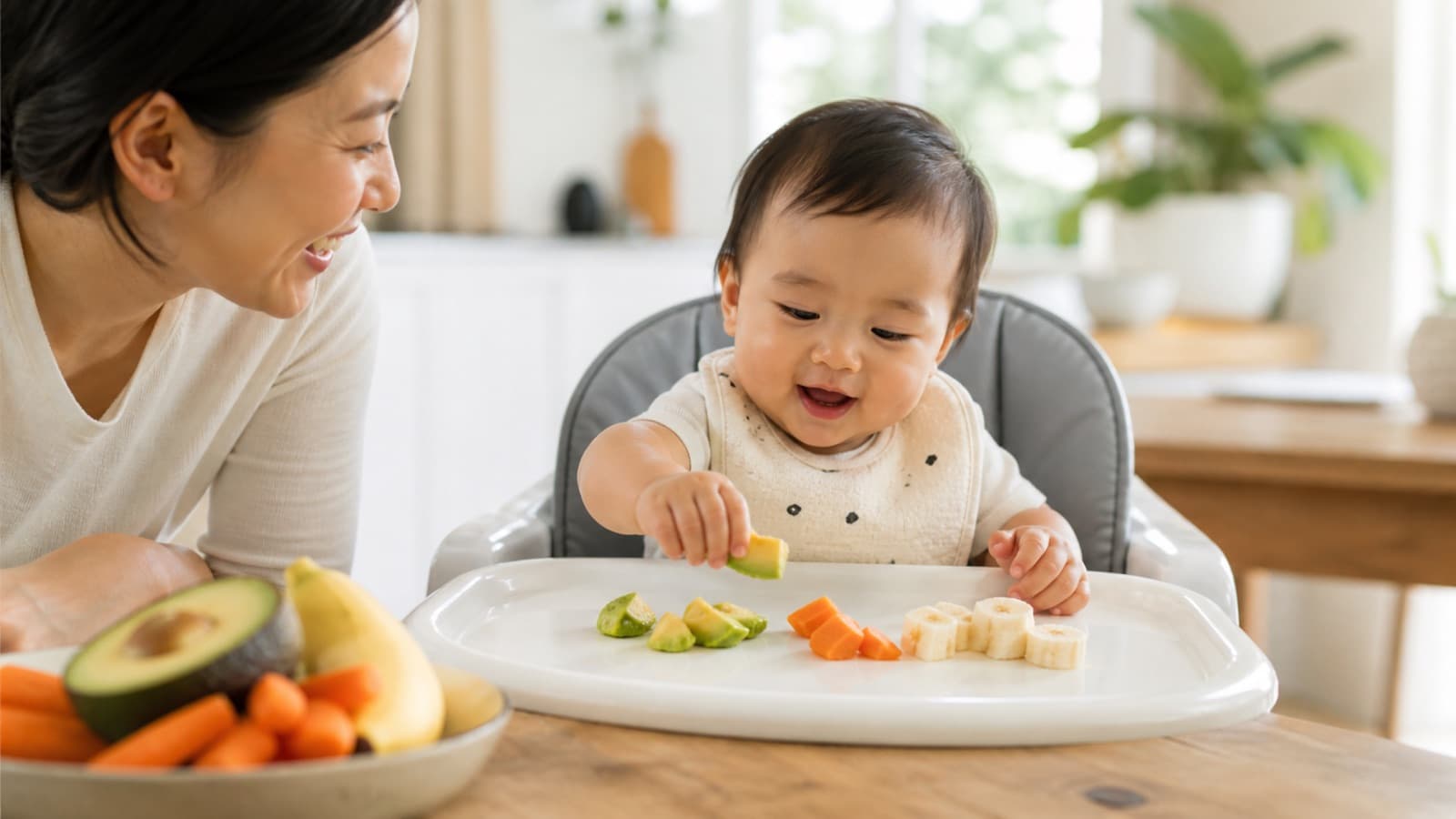
Finger foods can start at six months, at the same time as everything else. They aren't a later stage that a baby graduates to, which is the assumption most of us arrive with.
What changes over the following months is the shape of what you offer, and that depends entirely on her hand. I find this part fascinating, because the progression is precise and you can watch it happen.
How the grip develops
At around six months a baby uses a palmar grasp: the whole hand closes around an object, with the thumb doing very little. Two consequences follow, and both are practical.
She can't pick up anything small, and she can't open her fist to release food into her mouth. So what she needs is a strip long enough to be held in the fist with a portion sticking out above it, which she then gums off the top. A pea-sized piece or a small diced cube is no good to her yet, because she can't pick it up.
Between about eight and ten months the pincer grasp develops, thumb and forefinger opposing, and small pieces suddenly become possible and, briefly, fascinating. This is when you switch from strips to pea-sized pieces, and it's also when everything on the floor goes into her mouth, which is the same skill applied elsewhere.
As a physiotherapist I'd add one thing: self-feeding isn't only about food. It's repeated fine-motor practice with a strong motivator attached, and it feeds directly into everything that comes later with pencils and buttons.
| Age | Grip | Cut food as |
|---|---|---|
| 6-7 months | Palmar grasp. Whole hand, fist closes over | Finger-length strips, long enough to stick out of a fist |
| 7-8 months | Raking, transferring hand to hand | Strips, plus larger soft pieces |
| 8-10 months | Pincer grip developing: thumb and finger | Smaller pieces, pea to grape size, soft |
| 10-12 months | Neat pincer, deliberate release | Bite-sized pieces; most family food, adapted |
| 12 months+ | Spoon with intent, though messily | Small versions of what you are eating |
The squash test
One rule, applied to everything, every time. If it won't squash between your thumb and forefinger with gentle pressure, it isn't soft enough.
Babies have no molars and can't grind. What they do is compress food against the gums, so anything that resists compression will be swallowed in a piece. Cooked until soft is the standard, and steaming or roasting keeps more flavor than boiling.
Good first finger foods
All of these pass the squash test and all cut naturally into strips.
- Steamed broccoli and cauliflower florets, which come with a built-in handle.
- Roasted sweet potato, carrot, zucchini or parsnip in finger-length batons.
- Ripe banana or avocado, cut in long pieces and left partly in the skin for grip, since both are lethally slippery otherwise.
- Soft-cooked pasta shapes, large enough to hold.
- Strips of well-cooked chicken or soft meat, or flaked fish checked twice for bones.
- Toast fingers with a thin spread, and omelet or frittata cut into strips.
- Soft ripe pear or peach, and steamed apple, since raw apple is one of the classic choking foods.
Shapes to change or avoid
Shape matters as much as the food, and people skip this part.
Anything round and roughly the diameter of a windpipe is the highest-risk shape there is. Grapes, cherry tomatoes, large blueberries and hot dog rounds must be quartered lengthwise, never sliced into circles. Whole nuts and popcorn are out until at least four, and hard raw vegetables and hard fruit need cooking first. Large blobs of nut butter are hard to clear from the roof of the mouth, so thin it.
Cut anything stringy, like celery and some greens, into short lengths, because the fibers don't break down against gums.
Around the same stage
Moving off purées
Don't stay smooth for long. This is the mistake I see most often and the one with the longest tail.
Thicken within two or three weeks, introduce lumps by seven months, and be on soft chopped family food by nine or ten. There's evidence that babies who haven't met lumpy textures by around ten months are more likely to be selective eaters later, and the texture window is narrower than the flavor one.
A baby who has only ever had smooth food will gag on her first lump, and it's tempting to decide she isn't ready and go back to smooth. She gags because it's new. Going back only means it'll be new again next time.
When she can feed herself
From six months, if you give her the chance, she'll get food to her mouth with her hands. Spoons are a separate and much slower skill.
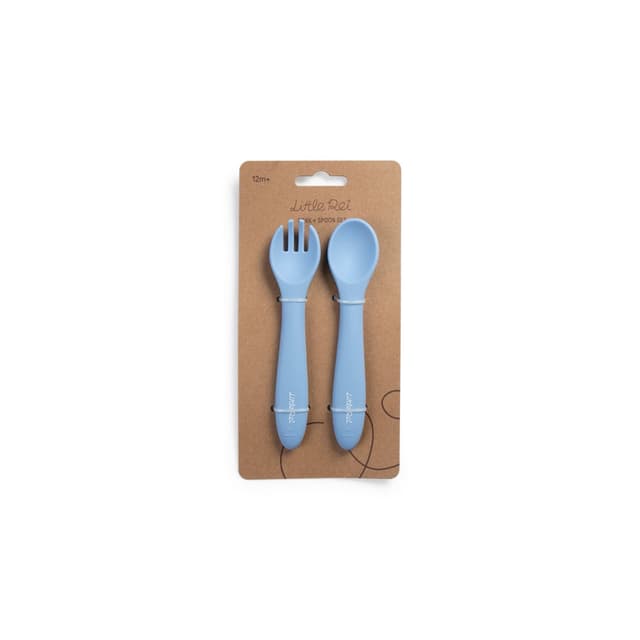
Give her a spoon at around eight or nine months and expect nothing from it for months. Preloading a spoon and handing it over is the intermediate step. Reasonably competent spoon use arrives somewhere between fifteen and eighteen months, and a fork rather later.
Let her be messy. Squashing, smearing and dropping are how a small child learns what food is, and a baby who's never allowed to handle food takes longer to accept it.
Expect gagging, and know the difference
Gagging is loud. There's coughing, spluttering, watering eyes, a red face, and a great deal of noise. It's a protective reflex working exactly as designed, it's extremely common in the first weeks, and it's how she learns to manage food in her mouth. The gag reflex in an infant is well forward on the tongue and moves back over the first year, which is the reason it fires so often at the start. Choking is quiet. No sound, or a weak ineffective cough, no crying, and the face changes color. Silence is the thing to react to.
Don't put your fingers in her mouth during a gag, don't lift her out of the chair, and try not to make a large reaction. She reads your face. Stay calm and let the reflex do its job.
Learn the infant choking response before you start solids, and have both parents learn it. Twenty minutes of instruction, and it's the difference between a frightening moment and an emergency.
What the research says
- Coulthard, Harris & Emmett (2009), Maternal & Child Nutrition 5(1):75-85: Delayed introduction of lumpy foods affects food acceptance and feeding at 7 years
- NHS. Your baby's first solid foods
- NHS. What to do if a child is choking
This guide is general information, written to help you understand a topic and ask better questions. It is not medical advice and does not replace your own doctor, midwife or paediatrician. Anything that worries you about your baby belongs with them.