

22 February 2026 · Eric Richfield
Commercial Director · Father of four
How Much Should a Baby Eat? Portions by Age
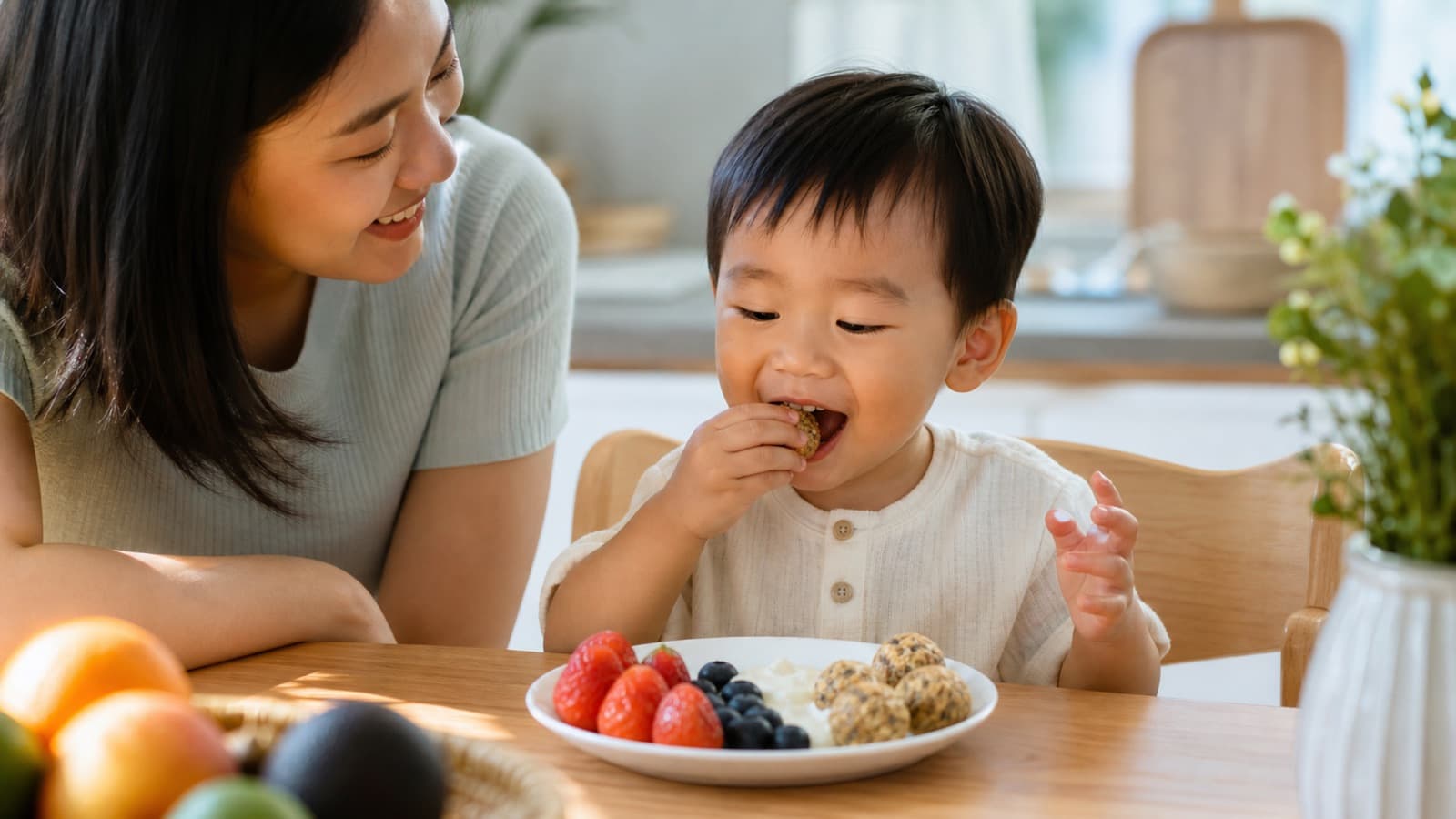
I have four children. Two are twins. The twins are why I no longer believe in a correct portion. Susan and Mary were born eleven minutes apart. They sit at the same table and get the same food from the same bowl. One eats about twice what the other does, and has since they started solids. Both are healthy. Whatever the chart says a two-year-old should eat, one of mine has ignored it for two years with no ill effects.
So here are the numbers, because you came for numbers. Then the part that matters more: what to do with them.
Meals per day, by age
The pattern matters a lot more than the quantity. You're watching the number of eating occasions climb while milk gradually comes down. That takes about six months.
| Age | Meals a day | Milk | Roughly how much solid food |
|---|---|---|---|
| 6 months | 1, building to 2 | 5-6 feeds, unchanged | 1-2 teaspoons, up to a few tablespoons |
| 7-8 months | 2–3 | 4-5 feeds | 2-4 tablespoons per meal |
| 9 months | 3 meals + 1-2 snacks | 3-4 feeds, around 500-600ml | 4-6 tablespoons per meal |
| 10-12 months | 3 meals + 2 snacks | 2-3 feeds, around 400-500ml | Approaching a small version of your meal |
| 12 months+ | 3 meals + 2 snacks | About 350-400ml whole milk | A third to a half of an adult portion |
Milk is the main event until around a year. People get that wrong both ways. Some drop it too early because solids are going well. Some keep it so high at eleven months there's no appetite left for anything else.
A better way to judge a portion
Use her hand. A serving of any one food is about the size of her fist. A meal is two or three of those.
It's a good rule. It scales with the child. You always have it with you. It also spares you tablespoon-counting, which I did diligently with my first and not at all by my fourth. Same results.
Offer the portion. If she finishes and still seems keen, offer more. Small amount, topped up, beats a mountain that mostly comes back. Better for her appetite. Better for your morale.
Elsewhere on portions
How much milk, and when it comes down
Six to eight months: milk continues essentially unchanged. Solids are practice, not nutrition.
Nine to twelve months: milk gives way, to around 500 to 600ml a day, then 400 to 500ml. Solids now do real work, especially for iron. Numbers are approximate. Could be wrong for your baby.
Twelve months on: about 350 to 400ml of whole milk a day. Much over 500ml fills a toddler up, blunts appetite and can interfere with iron absorption. That's the most common feeding mistake in the second year. Nobody warns you.
Why the amount matters less than it feels
Appetite isn't constant, and a child's is wildly variable.
She'll eat enormously for three days and almost nothing for two. She eats well before a growth spurt and badly when teething. She'll refuse on Tuesday the exact meal she demanded on Monday. Judge intake across a week. Most of what looks like a problem stops looking like one.
What tells you she's getting enough: growth along her own line on the chart, energy, wet nappies, and a child who's mostly cheerful. None of that is measured in tablespoons.
Signs they've had enough
Small children are decisive about this and the signals aren't subtle. The problem is we're trained to ignore them.
- Turning the head away, or leaning back from the spoon.
- Closing the mouth, or pushing the bowl away with real intent.
- Playing with the food and no longer eating it. That means the meal has ended even if the plate is full.
- Slowing right down, losing interest in what's on the tray.
- Getting fractious, which usually means the meal ended some minutes ago and nobody noticed.
When she stops, stop. No aeroplane. No three more spoons for me. No negotiating the end of a meal. A child who's allowed to stop when full learns to run her own appetite. Over thirty years that's worth a lot more than four spoonfuls of shepherd's pie.
Snacks, from around nine months
One or two a day. Set times. Treated as small meals.
The failure mode is grazing. A toddler with constant access to a pot of something never arrives at a meal hungry. Then you decide she's fussy. She isn't. She's full, because you've fed her all afternoon. I did it for most of a year with my second.
Water between meals. Milk at meals or as a snack. Juice essentially never. Fruit, cheese, yoghurt, toast and vegetable sticks all do the job.
When to ask someone
Most feeding worry sorts itself out. The following wants a professional eye on it.
- Weight that has fallen away from her own line on the growth chart, or has flattened over months.
- Fewer than four or five wet nappies a day, or an unusually lethargic child.
- Refusing entire food groups for weeks, particularly anything iron-rich.
- Coughing, choking or distress at nearly every meal, or a strong gag that hasn't eased with practice.
- No progression in texture by around ten months, so still on smooth purée only.
- Persistent vomiting, diarrhoea or blood in the stools alongside feeding.
What I checked
This guide is general information, written to help you understand a topic and ask better questions. It is not medical advice and does not replace your own doctor, midwife or paediatrician. Anything that worries you about your baby belongs with them.