

2 May 2025 · Eric Richfield
Commercial Director · Father of four
Tackling the Transition to Whole Milk

The switch to cow's milk is one of the few transitions in the first two years with an actual date attached. After eighteen months of everything being a spectrum, that's a relief.
When can a baby switch to cow's milk?
Twelve months as a main drink. Not before. The reason is iron. Cow's milk is low in it. It blocks absorption of iron from other food. In babies under one it can irritate the gut lining enough to cause slow blood loss. Iron deficiency in the first year has consequences for development that aren't easily undone. This is a firm rule.
Cow's milk in food is different and fine from six months. In a sauce, in porridge, in baking. Full-fat yoghurt and cheese are excellent early foods. It's milk as a drink that waits for the first birthday.
Whole milk, not semi-skimmed, until at least two. Toddlers need the fat for growth and for brain development. This is where adult nutritional instincts lead people astray.
How much milk does a toddler need?
About 350 to 400ml a day. A good deal less than most families end up giving.
Above roughly 500ml the problem runs in reverse. A toddler full of milk has no appetite for food, and the milk blocks iron absorption from the food she isn't eating. That's the most common cause of iron deficiency in the second year, and entirely avoidable. I think we caught it. Not sure.
Water between meals. Juice isn't needed at all. If it appears, well diluted, at a meal, where it does less damage to teeth.
How to make the switch
Some children don't notice. Two of mine switched in an afternoon and couldn't have cared less.
For the other sort, blend it in over a week or two, shifting the ratio and nothing else while you do it.
| Days | Usual milk | Cow's milk |
|---|---|---|
| 1–3 | 3 parts | 1 part |
| 4–7 | 1 part | 1 part |
| 8–11 | 1 part | 3 parts |
| 12+ | None | All |
| Any point | Slow down a step if she refuses | Change one variable at a time |
Serve it in a cup if you can. Doing both transitions at once is more efficient, and toddlers are more flexible than we credit. Warming it slightly helps in the first week for a child used to a warm bottle, and then drop it.
Around the same stage
What if they refuse it
Common, and not a problem in itself. Milk as a drink isn't essential. What counts is calcium, vitamin D and fat. There are other routes to all three.
- Full-fat yoghurt, cheese, and milk cooked into food all count and are frequently better received.
- Porridge made with milk, or a milky sauce over pasta, gets a surprising volume in unnoticed.
- Try it colder, or warmer, or in a different cup, since with toddlers the vessel is often the actual objection.
- Keep offering without pressure. It takes ten or more encounters, and making an issue of it guarantees a longer fight.
- Don't extend formula or follow-on milk indefinitely to solve this. It's expensive and it delays the problem.
If she takes very little dairy in any form, ask a health visitor or doctor about vitamin D and calcium. Don't work it out yourself.
What about toddler milks and plant milks
Toddler milks, growing-up milks and stage-three formulas aren't recommended by any health body I know of. A child eating a reasonable range of food doesn't need them. They're sweeter than cow's milk, they cost several times as much, and their main function is commercial. I say that as a commercial director, and I hope it has some weight.
Plant milks are a different question. Unsweetened fortified soya is the only one broadly considered a reasonable substitute in the second year, and it must be fortified with calcium and vitamin D. Almond, oat, coconut and rice milks are far too low in protein and energy to be a toddler's main drink. Rice milk specifically shouldn't be given under five, because of arsenic.
Avoiding dairy for allergy or family reasons? Do it with a dietitian, never alone. This is one of the few areas where the gap between right and wrong counts.
What about the bottle itself
Off bottles between twelve and eighteen months. Mainly for teeth.
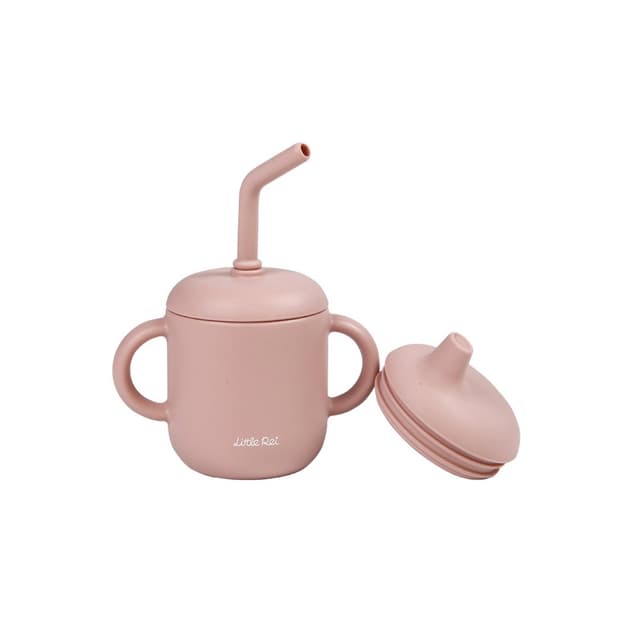
Introduce an open or straw cup from six months so it's old news by the time it counts. Daytime bottles go first, the bedtime one last. And never a bottle in the cot. Dentists would like that tattooed on every new parent. I've seen it ignored more than any other rule.
The ones people ask me
When can a baby start drinking cow's milk?
Most guidance puts cow's milk as a main drink at twelve months, with whole or full-fat milk through the second year. Cow's milk used in food, such as in cereal or sauces, is considered fine from around six months, and national guidance varies, so check yours.
How much milk should a toddler drink a day?
Commonly around 350 to 500 ml, roughly 12 to 16 fluid ounces, including milk in food, yoghurt and cheese. Above about 500 to 600 ml, milk starts displacing iron-rich foods and can contribute to iron-deficiency anaemia.
How do I switch my baby from formula to cow's milk?
Either straight over, or blended in steps across one to two weeks: three parts usual milk to one part cow's milk, then half and half, then one to three. Change one thing at a time: not bottle-to-cup and formula-to-milk in the same week.
What if my toddler won't drink milk?
It isn't essential. Calcium and fat are available from yoghurt, cheese, fortified plant milks, tinned fish with soft bones, calcium-set tofu and some greens and beans, and milk used in cooking still counts. Ask about vitamin D, which is often recommended as a supplement regardless.
Are toddler milks that deserve buying?
Most health authorities consider them unnecessary for healthy children over one. They generally cost more than cow's milk, often contain added sugars. And their health claims have been criticised by regulators in several countries.
Can toddlers drink plant milk instead?
Most plant milks aren't suitable as a main drink under two, being lower in energy, fat and protein and variably fortified. Fortified soy is the closest substitute. Rice drinks are advised against for young children in several countries. If avoiding dairy, involve a dietitian.
This guide is general information, written to help you understand a topic and ask better questions. It is not medical advice and does not replace your own doctor, midwife or paediatrician. Anything that worries you about your baby belongs with them.