

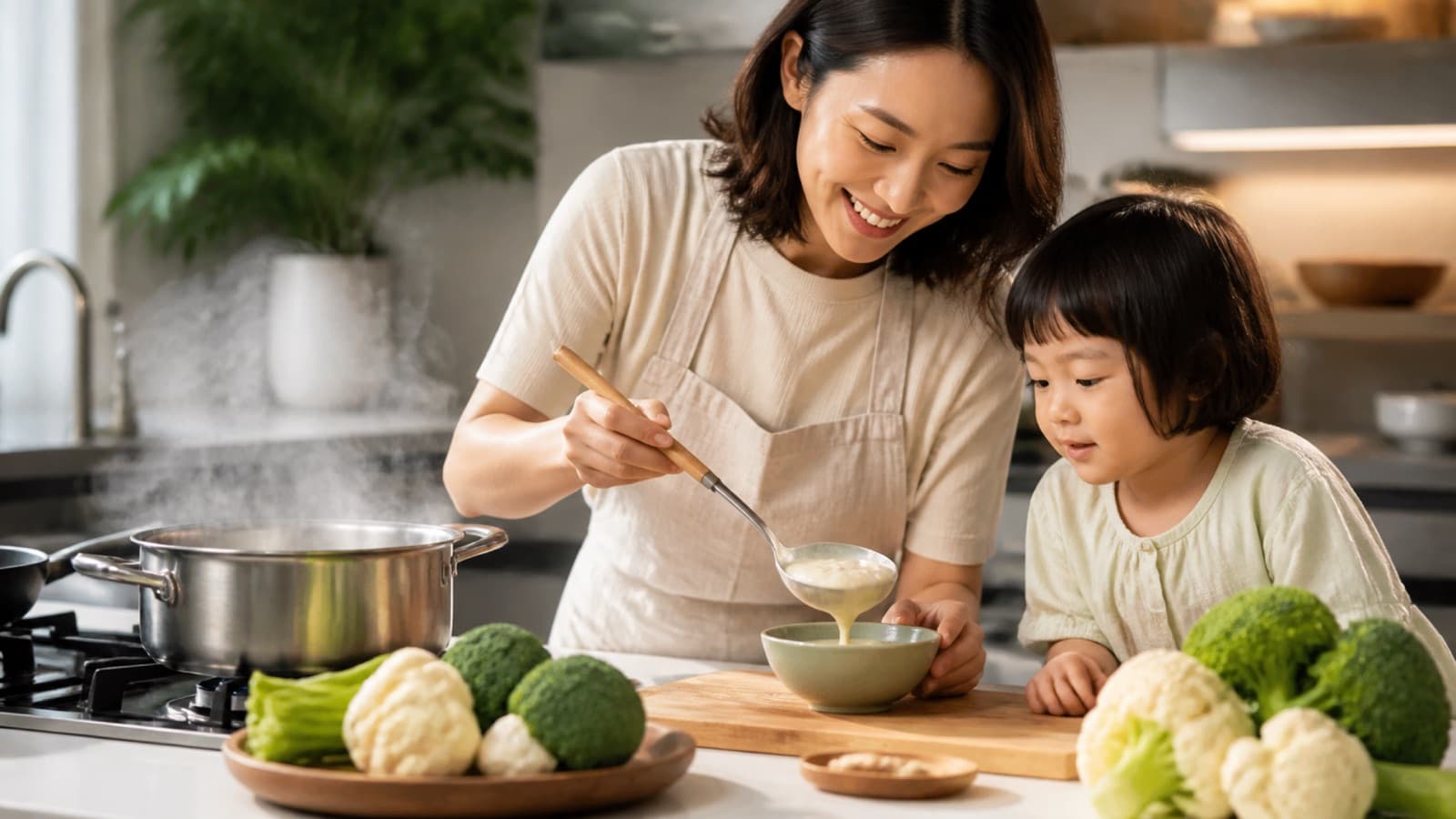
Two schools of thought on starting solids. A certain kind of parent will tell you at length which is correct. I've done this four times and used both, sometimes in the same meal. All four children now eat.
Here is what each involves, what the evidence says, and where the whole argument matters less than the people having it would like.
What each involves
Baby-led weaning: soft food in pieces, from about six months, which she picks up and feeds herself. No spoon, no purée. Purée-led: smooth food on a spoon, thickened over the weeks, then lumps, then finger food.
| Baby-led | Purée-led | |
|---|---|---|
| Start | Around 6 months, when able to sit and grasp | Around 6 months, sometimes marginally earlier |
| Form | Soft finger-length strips | Smooth, thickening over weeks |
| Who feeds | The baby | The adult, then increasingly the baby |
| Pace | Baby sets it entirely | Adult sets it, guided by cues |
| Mess | A lot | A lot, differently |
| Main appeal | Self-regulation, texture exposure, family meals | Reassurance about intake, easier out of the house |
The mess is the same. Anyone who says one is tidier hasn't done either.
What the evidence supports
Less than either side would like.
Trials comparing the two find no real difference in growth, choking risk, or later weight. There's some evidence that self-feeders regulate their intake better, and some that they accept a wider range of textures earlier. Both effects are modest.
What does predict how a child eats at four: repeated, low-pressure exposure to lots of flavours, and eating with adults who are eating the same thing. Both approaches deliver that if you let them.
Both routes, in practice
Where each helps
Baby-led suits a family that eats together and can adapt what's on the table. A baby who objects to the spoon. A parent relaxed about mess and about intake in the early weeks. It's also less work, and you aren't cooking separately. I think. My wife may dispute the less work part.
Purée-led suits a baby who was premature or has any trouble with oral coordination. A family that needs to know how much went in. Feeding out of the house. Anyone else doing the feeding. It's also the right choice if the whole thing makes you anxious. Anxiety transmits. A spoon is calming.
There's no prize for purity. Susan and Mary went different ways. Susan fought the spoon from week one. Mary regarded self-feeding as somebody else's job.
Doing both, which is what most people do
The commonest real-world approach, and the one I'd recommend to anyone: offer both from the start and let the child sort it out.
A couple of soft strips on the tray. A loaded spoon in your hand. She takes what she takes. Some meals go one way, some the other. By nine months the distinction has dissolved. Everyone ends up in the same place, a child eating family food in pieces.
Preload a spoon and hand it to her. That one trick satisfies both camps. It's how we got through the twins' first year without cooking three separate things.
Safety, which is identical for both
This is where I stop being amiable. The rules don't differ between approaches and they aren't negotiable.
Mentioned above
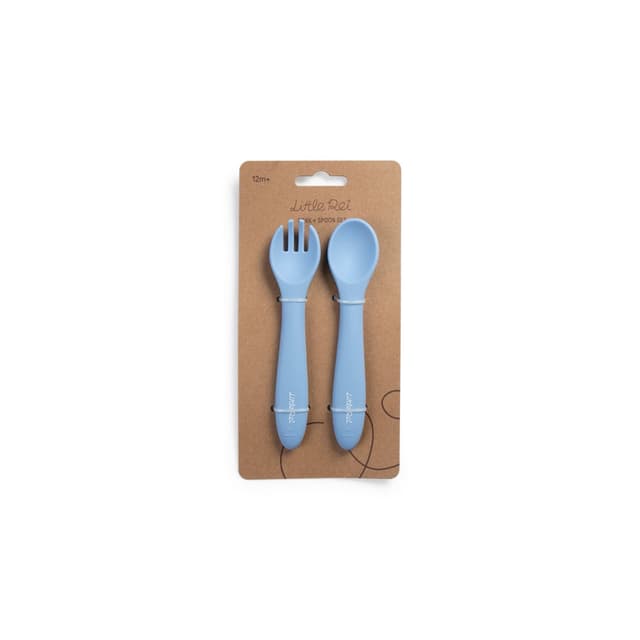 Self Feeding Setfrom S$12.90Shop now
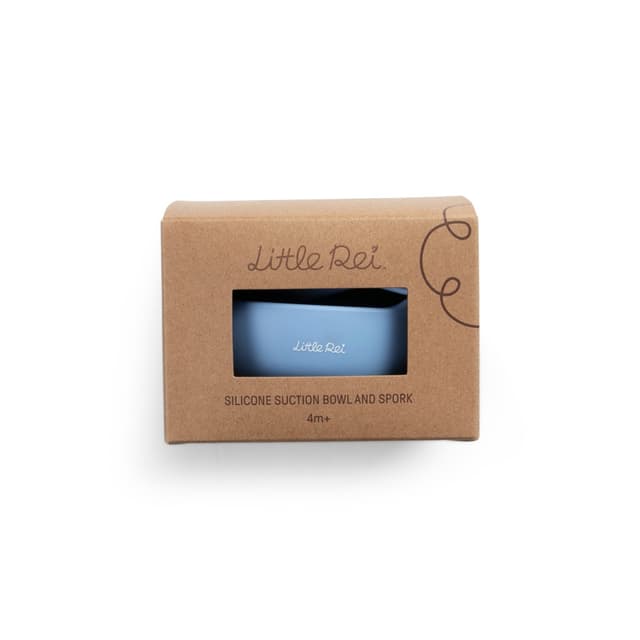 Suction Bowl with SporkS$19.90Shop now
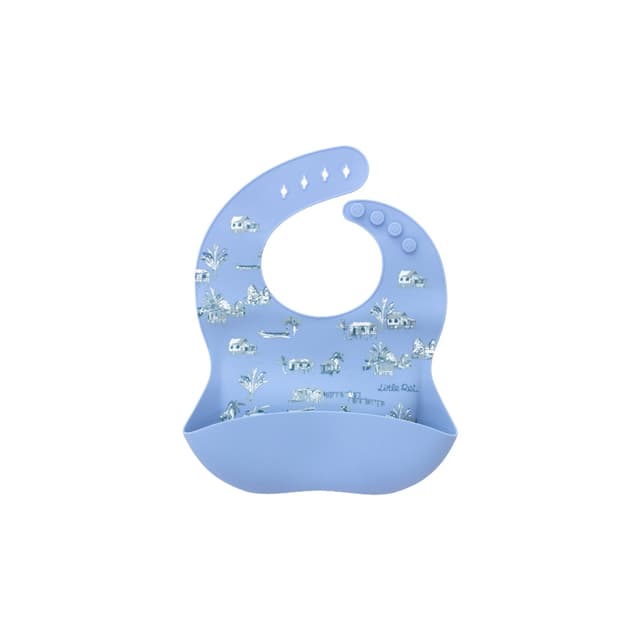 Silicone Rustic BibS$19.90Shop now
- She sits upright, in a proper chair with support, and never reclined or moving. No eating in a car seat, a pram or a bouncer.
- An adult stays within arm's reach for the whole meal, every meal.
- No whole nuts, no whole grapes or cherry tomatoes, no popcorn, no hard raw carrot or apple, no chunks of hard cheese, and nothing round the diameter of a windpipe unless it has been quartered lengthways.
- Soft enough to squash between your thumb and finger. If it won't squash, it isn't ready.
- Finger-length strips at the start, so she can hold one and have some sticking out of her fist.
- No food propped in a bottle, and no eating while walking, crawling or laughing.
- Learn the infant choking response before you start. Both parents, both approaches, no exceptions.
Gagging isn't choking. Gagging is loud and normal and part of learning. Choking is quiet. Know the difference before the first meal. Not during one.
Where that leaves you
Pick the one you'll keep doing. Consistency and cheerfulness at the table matter far more than the method.
Nobody has ever asked my twelve-year-old whether he was spoon-fed. Not once.
Straight answers
Is baby-led weaning safer or riskier than purées?
Studies comparing the two haven't found a higher rate of choking with baby-led weaning, provided high-risk foods are avoided and babies are always seated upright and supervised. Gagging is more visible with finger foods, which isn't the same as choking.
Can you combine baby-led weaning and purées?
Yes, and most families do. Offer a loaded spoon the baby takes themselves, purée at one meal and finger food at another, or the same meal in two forms. Combining isn't a failure of either approach.
Does baby-led weaning prevent fussy eating?
The evidence is mixed and not settled. The claim is plausible but not established well enough to choose on. Responsive feeding, following cues, never a target amount, has better evidence behind it and is available in both approaches.
Does baby-led weaning give enough iron?
It can, but it needs attention, because early self-fed foods are often lower in iron than fortified purées. Offer iron-rich foods in graspable form from the start: soft strips of red meat, chicken thigh, or lentil patties.
Where the numbers come from
- Fangupo et al. (2016), Pediatrics 138(4): A Baby-Led Approach to Eating Solids and Risk of Choking (BLISS trial)
- Daniels et al. (2015), BMC Pediatrics 15: Baby-Led Introduction to SolidS (BLISS) study protocol
- NHS. Your baby's first solid foods
- NHS. What to do if a child is choking
This guide is general information, written to help you understand a topic and ask better questions. It is not medical advice and does not replace your own doctor, midwife or paediatrician. Anything that worries you about your baby belongs with them.