

9 July 2026 · Roshni Mahtani Cheung
Cofounder, Little Rei · Mother of one
How Often Should You Change Your Child's Pillowcase or Buddy Pillowcase?

Weekly at the very least, twice a week in humid weather, and daily during any illness.
Why pillowcases get dirty so fast
A pillowcase collects everything a face produces over eight to eleven hours: sweat, saliva, skin oil, shed skin cells, whatever cream went on at bedtime and, in the case of a child, a certain amount of the day's dinner. It then spends the day in a warm room, and in this climate that combination works quickly. The effect isn't theoretical, because a face pressed into it all night is the most sensitive skin your child has, and a case that has gone three weeks is measurably different from one washed on Sunday. For a child with eczema this stops being cosmetic, since dust mite allergen accumulates in bedding and is a recognised trigger, and hot washing is the part of mite control with the best evidence behind it, so if eczema is in the picture at all, weekly is a floor and not a target.
How often should you wash a buddy pillowcase?
On exactly the same schedule as the head pillowcase, which surprises people, because a buddy pillow looks like a toy and gets treated like one.
It's held against the face, chewed, dribbled on, carried around the flat and dropped on the floor of at least one shopping centre. If anything it needs washing more often than the pillow under her head, and it's the one that gets forgotten.
The practical difficulty is that a beloved buddy pillow can't disappear into the machine for an afternoon. Own a second case. Swap it while she's at school or at breakfast, and the pillow itself never leaves the room.
Mentioned above
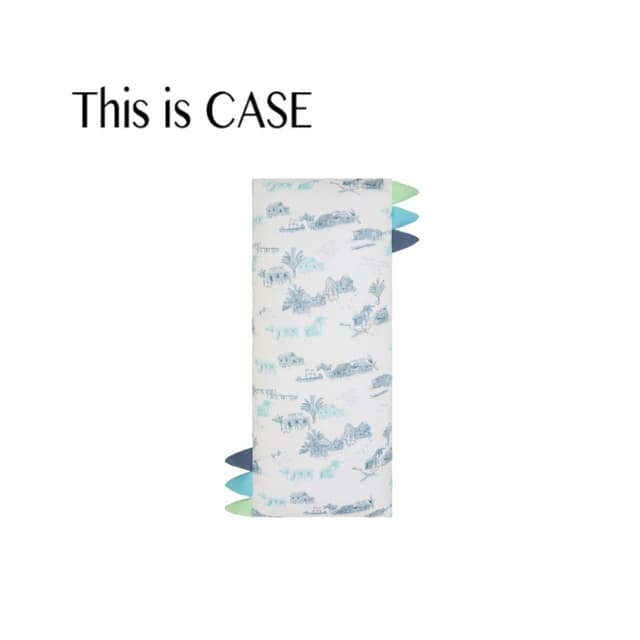 Baa Baa Sheepz Rustic Case (Medium)S$29.00Shop now
The rest of the bedding
| Item | Normal | In humid weather | During illness |
|---|---|---|---|
| Head pillowcase | Weekly | Twice weekly | Daily |
| Buddy or bolster case | Weekly | Twice weekly | Daily |
| The pillow itself | Check the label | Air it in sun monthly | After recovery |
| How many to own | Two per pillow | Two per pillow | Three is easier |
The washing routine that works
Nothing here is complicated. I've written it down only because the details are where it goes wrong.
- Wash at 60°C where the label allows it, because that's the temperature that deals with dust mites. Cooler washes clean the cloth without doing that job.
- Skip the fabric softener, and it coats fibres, reduces breathability, and is a common irritant on sensitive skin. Softness should come from the cloth.
- Use a non-biological or fragrance-free detergent if there's any eczema or reactive skin in the house, and run an extra rinse.
- Dry it thoroughly and quickly. Half-dry cloth left folded in a humid flat will smell within a couple of days, and airing in sunlight helps more than it sounds.
- Turn the case inside out to wash if it has a print you want to keep.
- Own two per pillow. This is the single change that makes the schedule survivable, and three is easier again if somebody in the house is prone to being sick at night.
Does the pillowcase fabric matter?
More than the pillow does, in my experience, because the case is the only part that touches her.
What you want is something soft, thin and breathable that moves moisture away from the skin and doesn't keep it there. Cotton percale does this well. Bamboo viscose does it well and gets softer with washing, so we make ours from it. Polyester satin looks luxurious and traps heat, which in a warm bedroom is the opposite of helpful.
Check the seams and any embroidery too. A raised seam or a decorative label under a cheek all night is exactly the sort of thing an adult never notices and a sensitive child can't ignore, and I know that because I missed it for years with my own daughter, whose sleep turned out to depend almost entirely on what her skin was touching.
Mentioned above
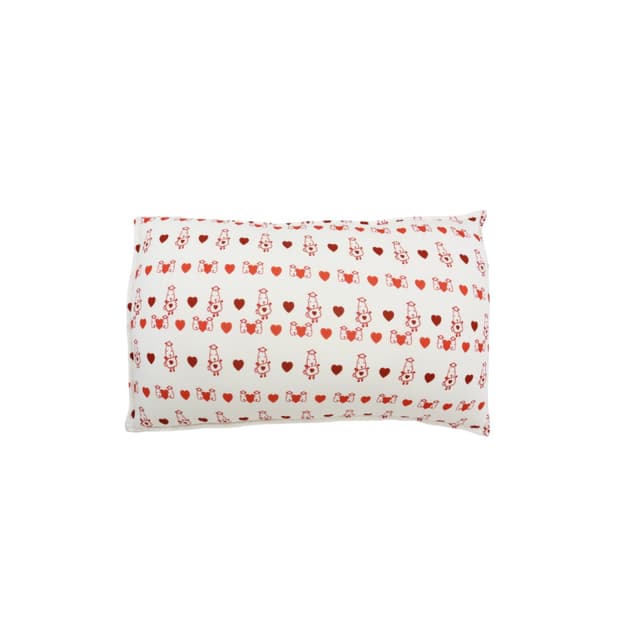 Baa Baa Sheepz Head Pillow (Kids)S$59.00Shop now
It needs saying clearly: a pillow isn't a baby item.
Under twelve months there should be no pillow in the sleep space at all, along with no duvet, no bumpers and no soft toys. A flat, firm, clear cot is what every safe-sleep authority recommends, and pillows are one of the things they specifically name. Most children move to a pillow somewhere between eighteen months and two years, usually when they move into a bed, and there's no benefit to being early. Shan moved at twenty months, I think, though I may be a month out.
Once she's old enough, the pillow becomes a load-bearing object. Shan has slept with hers for years, and there's a second one that lives permanently in the car.
Pick a day, attach it to something you already do, and stop thinking about it. Ours goes in with the sheets on a Sunday.
This is the smallest piece of household maintenance in the house and one of the few that touches your child's skin for eleven hours a night, and it took me an embarrassingly long time to give it the weight it deserved.
This guide is general information, written to help you understand a topic and ask better questions. It is not medical advice and does not replace your own doctor, midwife or paediatrician. Anything that worries you about your baby belongs with them.