

29 August 2025 · Maia Hillsborrow
Marketing Director · Mother of five
Why Do Babies Babble? A Guide to First Words
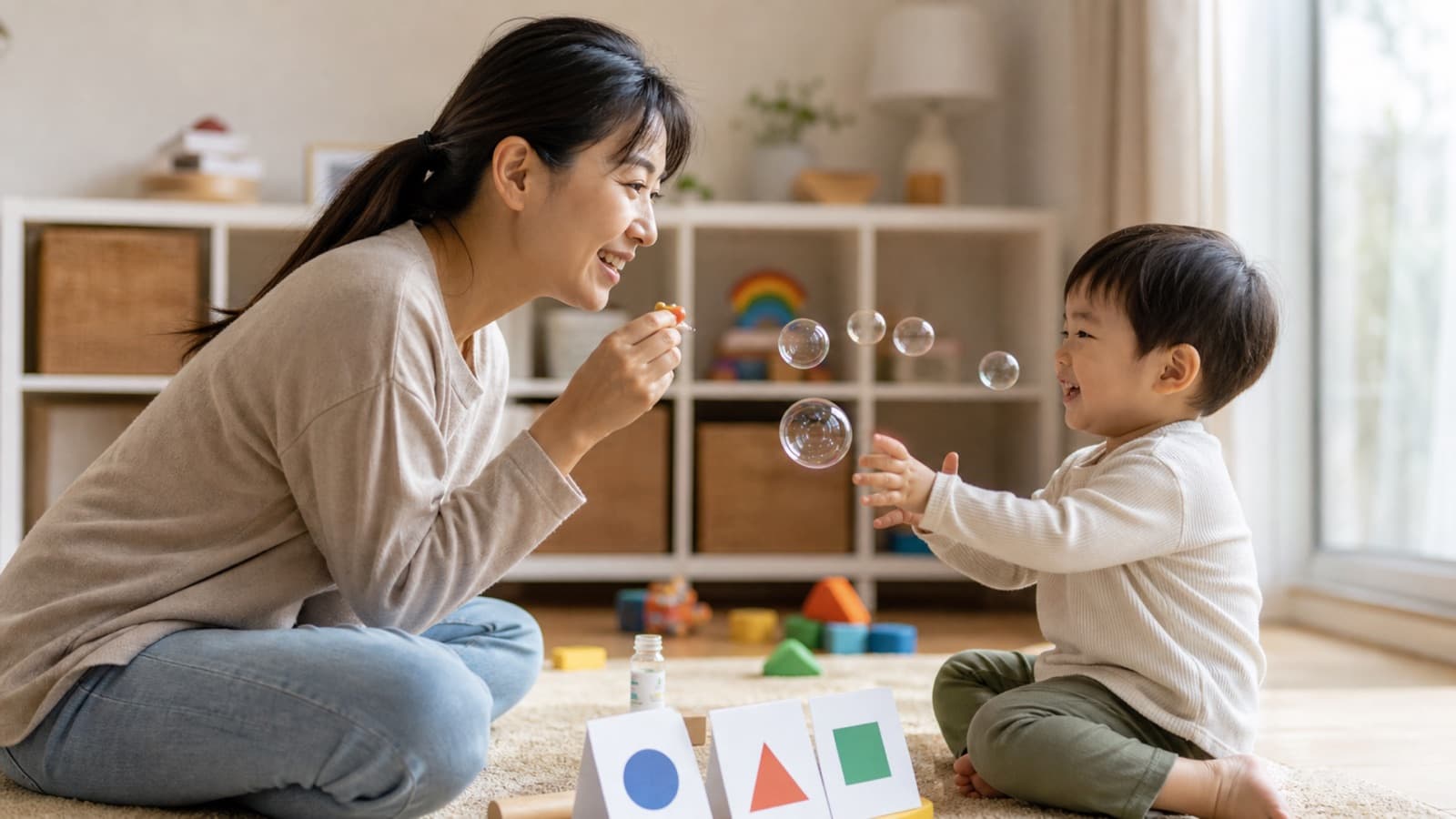
Katherine didn't really talk until she was almost three, and I spent a good part of her second year holding two thoughts at once: that she was fine, and that I should do something. Both turned out to be true, and I want to start there, because if you've landed here at eleven at night you're probably holding those same two thoughts.
Babbling sounds like noise for its own sake, and some of it is. The rest is rehearsal, and it's far more organized than it sounds. Your baby is discovering which sounds her mouth can make, listening to herself make them, and gradually setting aside everything that doesn't belong in the language she keeps hearing around her.
The stages, and the very wide margins around them
Babies move through these in the same order and at different speeds. I have five children and no two of them arrived at the same place in the same month, which is the most reassuring sentence I can offer you.
| Age | What it sounds like | What is happening |
|---|---|---|
| 0-2 months | Crying, grunts, small throat sounds | Reflexive; the vocal tract is still high in the throat |
| 2-4 months | Cooing: ooh, aah, gurgles | Vowel practice; turn-taking begins |
| 4-6 months | Squeals, growls, raspberries, pitch play | Testing the range of the instrument |
| 6-10 months | Bababa, dadada: repeated syllables | Canonical babbling; consonant and vowel combined |
| 10-12 months | Varied strings with speech-like rhythm | Jargon; sounds like sentences without words |
| 12-18 months | First words, then a handful more | Meaning attaches to sound |
| 18-24 months | Vocabulary jumps; two words together | Combining begins. 'more milk', 'daddy gone' |
Why babbling counts so much
Four things are happening at once, and none of them looks like work from the outside. The first is motor practice. Speech requires precise coordination of tongue, lips, jaw and breath, and babbling is where a baby builds it. As a physiotherapist I find this the easiest part to explain, because it's the same principle as any other motor skill: the repetition isn't incidental, it's the mechanism. The second is auditory feedback. Babies listen to themselves and adjust, which is the reason babbling develops differently in deaf infants, and the reason deaf babies exposed to sign language babble with their hands. The third is narrowing: early babbling contains sounds from many languages, and by around ten months it has mostly narrowed to the ones your baby hears.
The fourth is social. Babies babble more when somebody answers them. That pattern of babble, pause, babble is a conversation happening before there's anything to say, and the pause is her turn.
Helping it along
Why dada usually comes first
It isn't favoritism, whatever anyone in your family says about it at dinner. The /d/ and /b/ sounds are made at the front of the mouth and are mechanically easier than /m/ held with a vowel under control.
Both usually arrive as pure sounds long before they're attached to a person, so a four-month-old saying dada is producing a syllable, not making an identification. She'll get there. Enjoy the syllable in the meantime.
What helps
Almost all of it is talking to her and then stopping. The stopping is the part we all skip, myself very much included.
Respond to her babble as though it were speech: answer, wait, answer again. That pause is where she takes her turn, and adults fill it far too quickly. Narrate what you're doing and what she's looking at, because the sheer volume of speech a baby hears is the strongest predictor of her vocabulary that you have any control over.
Use real words alongside the simplified ones. Baby talk with warm exaggerated intonation helps her pay attention, while a shrunken vocabulary doesn't help at all. Read from birth and let her choose the same book forty times, which she will. Name whatever she points at, because pointing at around twelve months is a request for a label and answering it is high-value. That's my reading, anyway: the evidence on pointing is stronger than the evidence that answering it helps.
Sing, since rhythm and repetition make sound patterns easier to hold on to. Turn off the television when nobody is watching it, because background noise measurably reduces the amount and quality of speech directed at a baby. Don't correct her pronunciation. Say it back correctly and move on: "yes, that's your bottle" does the whole job, and "say it properly" does none of it.
Comprehension runs a long way ahead of speech
Much further than most of us expect. A one-year-old with two or three spoken words may well understand fifty.
This is the thing I wish somebody had told me earlier with Katherine. What counts most is whether she follows simple instructions, looks at the right object when it's named, and responds to her own name. A quiet child who understands everything is in a very different position from a quiet child who doesn't, and knowing which one you have changes how the waiting feels.
If you're raising a bilingual child
Growing up with two languages doesn't cause speech delay. Bilingual children reach first words, first word combinations and early vocabulary growth inside the range expected of monolingual children.
The confusion comes from how they get measured. Test a bilingual child in one language and you'll undercount her, because her words are split across two, and that applies even for the language she seems strongest in. Researchers get around it by counting the concepts she has a word for in either language, and scored that way bilingual toddlers have vocabularies comparable to everyone else's.
This one is personal. We're an expat family in Bangkok, our children are growing up between languages, and plenty of well-meaning people will tell you to drop one. Mixing languages inside a sentence is completely normal and isn't confusion. What helps is generous exposure to each, from people who speak it comfortably.
Signs that deserve raising, and why I would raise them early
Most of these are absences, which is exactly what makes them easy to miss.
Watch for no babbling by around nine months, and for no response to sound or no turning toward a voice at any age. Watch for no gestures, pointing, waving, showing, by twelve months, no single words by around eighteen months, no two-word combinations by around two, and speech that close family can't understand at all by three.
Act quickly if a child loses words or babble she previously had. That warrants prompt attention.
Check hearing first, always. Intermittent hearing loss from glue ear is common, easily missed, and looks exactly like a child who isn't talking yet.
Here's the part I feel strongly about. We were told to wait and see with Katherine, twice, by people who meant well. When we finally saw a speech and language therapist she was straightforward about what would help, and it helped. In a great many places you don't need a doctor's referral to make that appointment yourself.
Please hold both thoughts, exactly as I did. Your child is very probably fine. Go and get her assessed anyway. Early input consistently beats waiting, and I've never once met a parent who regretted asking too soon.
What the research says
- Hoff et al.: Dual language exposure and early bilingual development
- NHS. Help your baby learn to talk
- CDC: Developmental milestones
This guide is general information, written to help you understand a topic and ask better questions. It is not medical advice and does not replace your own doctor, midwife or paediatrician. Anything that worries you about your baby belongs with them.