

21 July 2026 · Samantha Lin
Designer · Mother of two
The Importance of Reading to Your Baby + 10 Best Books
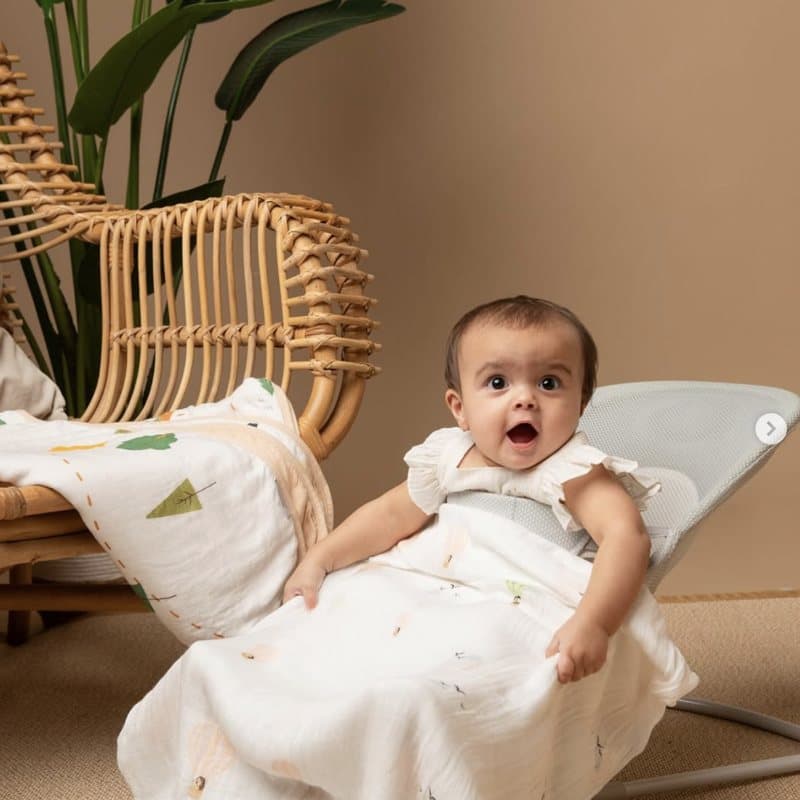
We read to Richard in Mandarin and in English from the beginning, and for a long time I worried that doing both was making a mess of it. He's three now and switches between them without appearing to notice, which is apparently the ordinary outcome.
Charles is one and currently eats the books. That's also reading, and I'll come to why.
What does reading do for a baby who can't understand words?
Almost none of the benefit is comprehension, which is the thing that stops people starting early. What she's getting is the sheer volume of language. The number of words a child hears in her first years is one of the strongest predictors of her later vocabulary that anybody has any control over, and books are unusually dense in words you'd never say otherwise. Nobody narrates a nappy change using the word marvellous. A book does it for you. She's also getting your voice, your attention, and the same warm arrangement every time, so paediatric bodies now recommend reading aloud from infancy as a matter of routine care. And she's learning what a book is: that it opens, that the pictures relate to the sounds, that the page turns in one direction. That's print awareness, and it's being built long before any of it is understood.
No, you aren't teaching her anything here. You're giving her language, attention and a habit, and the three of those together go a long way.
How should you read at each age?
Differently, and the change is mostly about how much you let her wreck it.
Under six months, she's looking at your face more than the page, so this is really talking with a prop. High-contrast black and white images hold her attention; the words hardly matter and you can read whatever you happen to be reading yourself.
From six to twelve months, the book becomes an object. She'll grab it, chew it, close it, and hit it. Board books and cloth books exist for exactly this, and letting her handle them is part of it. Charles has never once let me finish a page.
From one to two, she starts pointing, and pointing is a request for a label. Naming whatever she points at is high-value, and the reading turns into a conversation with the book as the subject. From two, she can tell you what happens next, and the same book forty times becomes the entire point.
Across all of it: stop when she's done, however early. Two minutes finished cheerfully is better than ten minutes endured.
How language arrives
Ten books that hold up
Chosen because they survive being chewed, they work read aloud, and none of them depends on a cultural reference a child here wouldn't have.
- Guess How Much I Love You: Sam McBratney. The bedtime one. Works from birth for the rhythm alone.
- The Very Hungry Caterpillar: Eric Carle. Counting, days, food, holes to put a finger through. Available in Mandarin, which counts below.
- Brown Bear, Brown Bear, What Do You See?, Bill Martin Jr and Eric Carle. Repetitive to the point of being hypnotic, which is exactly what a one-year-old wants.
- Dear Zoo: Rod Campbell. Flaps. The flaps will be destroyed and the destruction is a good sign.
- Where's Spot?, Eric Hill. Same, and the first book many children anticipate.
- Goodnight Moon: Margaret Wise Brown. Quiet, slow, and built for the last five minutes of the day.
- Peek-a Who?, Nina Laden. Board pages, a mirror, and short enough to finish.
- Ten Little Fingers and Ten Little Toes: Mem Fox and Helen Oxenbury. Babies from everywhere, which is a small thing and not nothing.
- That's Not My… series: Fiona Watt. Textures to touch. The strongest first-birthday books there are.
- Press Here: Hervé Tullet. For the older end, two and up, and the closest a paper book gets to being interactive.
Then add whatever you loved, in whatever language you loved it in. A book read with pleasure beats a better book read dutifully.
Reading in more than one language
This is the part most lists leave out entirely, and here it applies to nearly everybody.
Growing up with two languages doesn't cause delay and it doesn't cause confusion. Bilingual children reach first words and early vocabulary inside the range expected of everybody else. What trips people up is the measuring: count a bilingual child's words in one language and you'll undercount her, because her vocabulary is split across two. Counted properly, across both, she's where she should be.
The practical version for a household like ours: read in whichever language you speak most naturally, since fluency and warmth transmit better than correctness. We do Mandarin first and English second because that's the order I speak them in, and my husband does his own. Mixing within a sentence is normal and isn't a problem. I'm not sure my mother-in-law agrees. She reads in Mandarin only, which is fine too.
Bilingual editions help, and so does simply reading an English book aloud in Mandarin. Nobody is marking you, and a one-year-old doesn't know what the text says. There are more Mandarin-English titles available here than anywhere I've lived, so use them.
How to build the habit when there's no time
Attach it to something that already happens, so it needs no decision.
Ours is after the bath and before the cot, every night, because that slot already existed. Two books, always in the same order, and it takes six minutes. On the bad nights it's one book and it still counts.
Keep books where the children are: a basket by the sofa, two in the nappy bag, one in the car. Charles's grandmother reads to him on weekdays because there are books in the room she uses, which required nothing from me except leaving them there. Let them choose, including the same one every night for a month, because the repetition is doing the work.
How much reading is enough
Less than the internet implies. Ten to fifteen minutes a day is a good habit and there's no threshold below which it stops counting.
Two minutes is better than none. A page and a half before she squirms off your lap is a complete session at ten months. Consistency across the week counts for more than duration on any evening, and a child who's read to briefly every day is in a better position than one who gets forty minutes on Sunday.
The numbers people quote, a thousand books before school, and so on, are motivational devices. Three books a day for a year gets you there without anybody counting, and counting is the surest way to make it feel like homework for both of you.
This guide is general information, written to help you understand a topic and ask better questions. It is not medical advice and does not replace your own doctor, midwife or paediatrician. Anything that worries you about your baby belongs with them.