

10 November 2025 · Maia Hillsborrow
Marketing Director · Mother of five
Marking Milestones in Your Baby's First Year
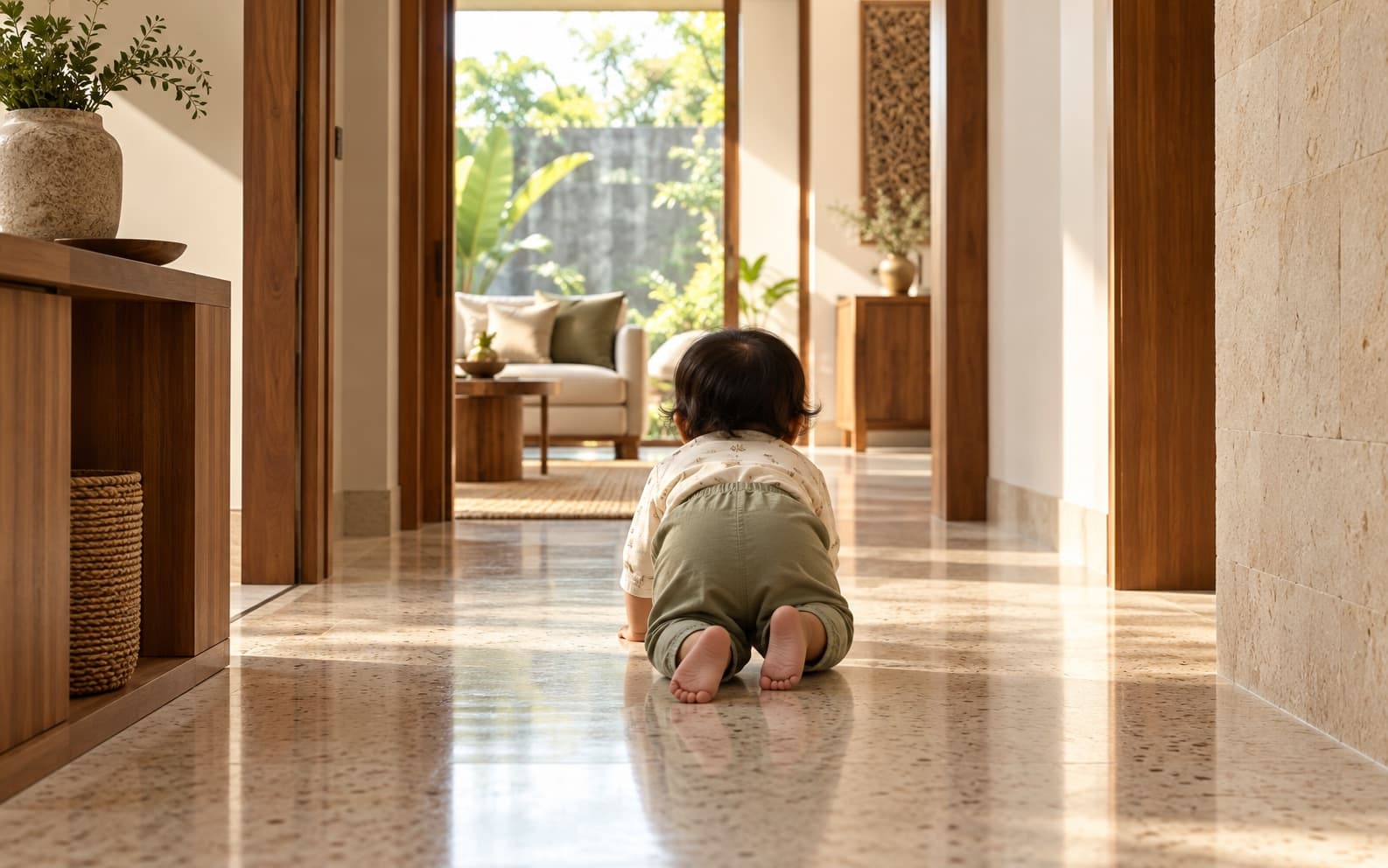
Milestone charts are helpful and stressful in about equal measure. They're built from averages, so on any line about half of all perfectly typical babies will be behind the number. Somebody has to be.
Katherine was that baby for us with speech, and I spent a lot of her second year reading charts at midnight.
The first year, by quarter
Every figure below is a middle. Half of all babies reach each one later than the number given.
| Around | Movement | Communication | Social |
|---|---|---|---|
| 0-3 months | Lifts head during tummy time, unfolds from newborn curl | Coos, different cries | First social smile, 6-8 weeks |
| 4-6 months | Rolls one way then both, sits with support | Babbles, laughs, turns to voices | Recognises familiar faces, reaches to be held |
| 7-9 months | Sits unsupported, may crawl or shuffle | Babble strings: bababa, dadada | Separation awareness begins, plays peekaboo |
| 10-12 months | Pulls to stand, cruises, may take steps | First words, points at things | Waves, offers objects, follows your gaze |
Two more things to keep in mind. Babies born early should be tracked by corrected age, from the due date, for at least the first two years. And development isn't a queue: a baby pouring everything into learning to walk will often pause on words for a month, and the reverse happens just as commonly.
Why the ranges are so wide
These ranges have been measured, which I find very reassuring. The WHO Motor Development Study followed children in Ghana, India, Norway, Oman and the United States from four months until they walked, and published the actual windows between the 1st and 99th percentiles. Sitting without support runs from 3.8 to 9.2 months, crawling on hands and knees from 5.2 to 13.5, standing alone from 6.9 to 16.9, and walking alone from 8.2 to 17.6 months. Please read that last one twice. Nine and a half months separate the earliest normal walker from the latest one. A baby walking at eight months and a baby walking at seventeen are both comfortably inside the normal range, and the charts in baby books never show that.
One more finding from the same study, for anybody watching a baby who shows no interest whatsoever in crawling: 4.3% of those children never crawled on hands and knees at all. They got where they were going another way. It isn't a step that has to happen.
Other milestones vary just as widely. Independent walking is normal anywhere from about nine months to eighteen, and both ends are ordinary. Plenty of babies never crawl, and bottom-shuffling, commando crawling and going straight to walking are all within normal. First words come anywhere between about ten months and fifteen, with comprehension running well ahead of speech at every stage. Teeth arrive between four months and twelve and predict nothing about anything else. Floor time makes a difference too, because that's where babies build the strength the chart measures.
The ones parents watch for
The signs that deserve raising
Being late with one thing is rarely a problem on its own. What needs a conversation with a doctor or health visitor is a pattern, a loss, or an asymmetry.
Raise it if she loses a skill she previously had, whether that's words, babble, waving or movement. Raise it if there's no social smile by around three months, or no response to sound and no turning toward a voice. Raise it if she uses one side of her body noticeably more than the other, or shows a strong hand preference before twelve months. I'm not sure every one of those is a red flag on its own, though together they are.
Raise it if she isn't sitting with support by around nine months or not bearing weight on her legs, if there's no babbling, pointing or gesturing by twelve months, or if you notice persistent stiffness or persistent floppiness.
Raising a concern early costs you one short appointment. Where something is going on, early support is consistently more effective than later support, and the great majority of these conversations end in reassurance. Ours ended in a referral that helped, and I've never once regretted making the call.
The milestones nobody charts
The official list is a clinical tool, and most of what you'll remember isn't on it.
The first time she recognizes you across a room and her whole body reacts. The first proper belly laugh, usually at something entirely inexplicable. The first night you both sleep through and you wake up worried, not tired. The day she starts handing you things, which is an early and deliberate act of sharing.
The first time she comforts herself with a familiar blanket. The moment she works out that a dropped spoon can be dropped again, and again, and that you'll keep picking it up.
Keeping a record without it becoming a project
The records that last are the low-effort ones, so plan for the exhausted version of yourself. One line a week in a note on your phone will beat any album you don't fill in.
Photograph the ordinary things, the high chair, the stroller, the corner of the room, and not only the occasions, because the background is what you'll want back later. Take one photo a month in the same spot with the same blanket, and let the change in size tell the story, with no styling.
Record the sounds, please. Everybody photographs and almost nobody records, and the babble is the thing that vanishes most completely. I have four seconds of Katherine at eighteen months making a noise that wasn't quite a word, and I wouldn't trade it for a hundred photographs.
Keep one object, the first muslin, the first shoes. Resist the comparison, because the baby walking at nine months and the baby walking at sixteen are, by four, entirely indistinguishable on a playground.
What the research says
- WHO Multicentre Growth Reference Study Group (2006), Acta Paediatrica Suppl 450:86-95: WHO Motor Development Study: windows of achievement for six gross motor development milestones
- NHS: Baby development milestones
- CDC. Developmental milestones and Learn the Signs. Act Early.
This guide is general information, written to help you understand a topic and ask better questions. It is not medical advice and does not replace your own doctor, midwife or paediatrician. Anything that worries you about your baby belongs with them.