

8 April 2026 · Jennifer Wijaya
Finance Director · Mother of one, expecting
Bamboo vs Conventional Diapers
The diaper aisle is where marketing goes to make claims nobody checks. Everything is natural, gentle, breathable and hypoallergenic, whatever that means this week.
Know what a disposable diaper is. Once you do, the comparison is simple and a good deal of the packaging is funny.
What is inside a disposable diaper
3 functional layers, essentially unchanged for 40 years.
| Layer | What it is | Does bamboo change it? |
|---|---|---|
| Top sheet | The only layer touching skin. Conventionally a polypropylene non-woven. | Yes. This is the layer a bamboo diaper replaces |
| Absorbent core | Fluff pulp plus superabsorbent polymer, which turns liquid to gel. | No. Essentially every disposable uses SAP |
| Back sheet | A waterproof film, sometimes microporous so vapour escapes. | No. This is what the word "breathable" on the packet refers to |
The packaging won't tell you this: SAP is what makes a modern diaper work and every disposable contains it, bamboo ones included. A diaper marketed as bamboo is a diaper with a bamboo-derived top sheet. It isn't a diaper made of bamboo.
So what does bamboo change
It changes the layer against the skin. That isn't nothing, since it's the only layer the skin ever meets.
Bamboo viscose is smoother and rounder in cross-section than a polypropylene non-woven, so there's less friction, and it moves moisture off the skin instead of letting it stay at the surface. In a climate where friction and surface dampness are 2 of the 4 drivers of diaper rash, that's a real advantage.
Also a modest one. It won't rescue a diaper left on for 5 hours. Interval beats material, every time.
Which claims deserve scepticism
We sell bamboo textiles and, since 26 September 2026, a luxury disposable diaper with a bamboo-infused topsheet. That gives us every commercial reason to let these slide. I'd rather we were the brand that tells you.
| Claim | Verdict |
|---|---|
| Naturally antibacterial | No. Raw bamboo contains antimicrobial compounds; the viscose process dissolves the plant structure and they don't survive into the fibre. The US FTC has acted against this claim. |
| 100% biodegradable | Almost never true of a whole diaper. The top sheet may be. The SAP core and waterproof back sheet aren't. |
| Chemical-free | Meaningless. Viscose is a chemical conversion process. Sustainably sourced is defensible; chemical-free isn't. |
| Hypoallergenic | Unregulated term. What's real is a certification you can look up, such as OEKO-TEX, and no added fragrance. |
| Eco or plant-based | Check what proportion, and of which layer. It's usually the top sheet. |
The claims, in context
What to compare
4 things, in order of importance.
| Priority | What to check | Why |
|---|---|---|
| 1 | Fit on your baby | The best diaper in the world leaks if the thigh cuff is wrong. This outweighs every material consideration. |
| 2 | Fragrance and lotions | Added scent is a common irritant with no benefit. Unscented, every time. |
| 3 | Top sheet material | It's the only layer touching skin. |
| 4 | Absorbency for your use case | Especially overnight, where a weaker diaper costs more in laundry than it saves in price. |
Everything else, the print, the wetness indicator, the recyclable outer bag, is a preference.
A note on what we sell
Our Luxury Tape Diapers and Luxury Pull-Up Diapers went on sale on 26 September 2026. Both are a disposable with a bamboo-infused topsheet. The word on the front of the pack is luxury, and the bamboo is one layer of it.
They have a silky, double-layered, bamboo-infused topsheet with no cooling additives, a totally chlorine-free build, and a high-absorbency core, because a diaper without one doesn't work, and we aren't going to pretend otherwise.
Mentioned above
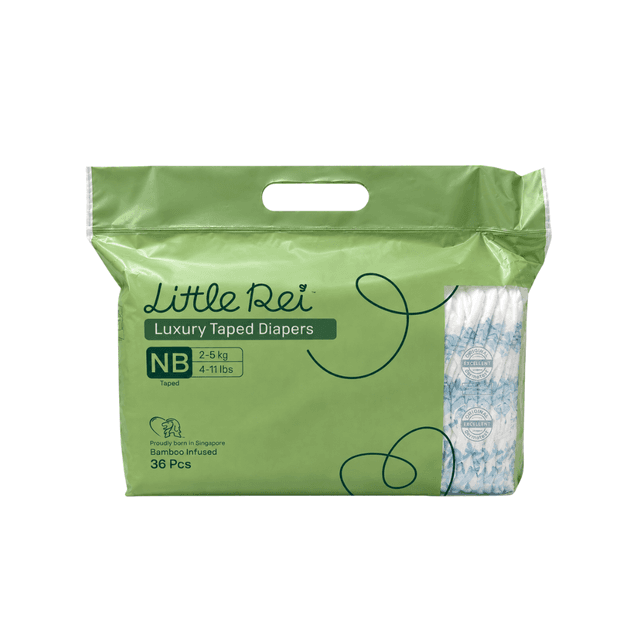 Eco-Conscious Luxury Tape Diapers (Full Pack)S$16.90Shop now
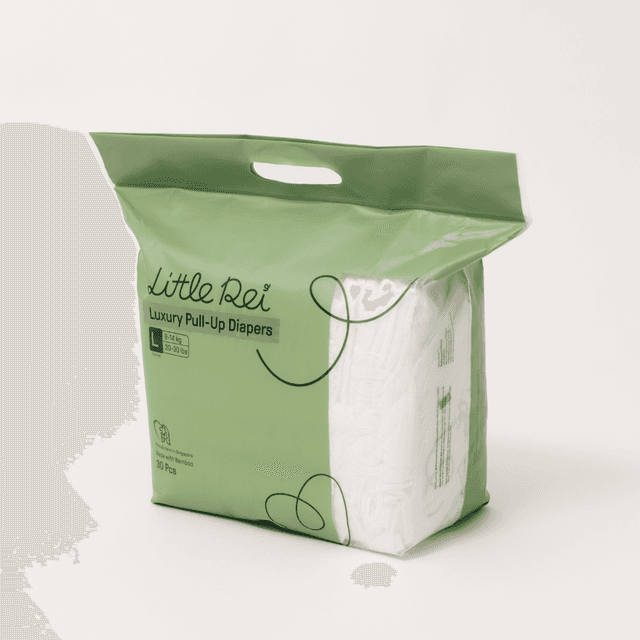 Eco-Conscious Luxury Pull-Up Diapers (Full Pack)S$21.90Shop now
What the difference costs over a year
I've compared materials so far without mentioning money. Odd, for something you buy roughly 2,500 times.
Every figure below is one retailer on one day, so price your own brands before you trust the gap. What doesn't move is the number of diapers, and that decides the total.
| Age | Per day | Days | Running total |
|---|---|---|---|
| 0-1 month | 10–12 | 30 | 300–360 |
| 1-5 months | 8–10 | 120 | 1,260–1,560 |
| 6-12 months | 5–6 | 210 | 2,310–2,820 |
| Year one total | — | — | roughly 2,300-2,800 |
| Year two | 5–6 | 365 | a further 1,800-2,200 |
Now the only sum that counts. Pack price divided by pack count gives cost per diaper. Multiply by 2,550 for a rough first year. I haven't checked that count against our own. It felt like more.
| Cost per diaper | First year, ~2,550 diapers | Difference against S$0.25 |
|---|---|---|
| S$0.25 | about S$640 | — |
| S$0.35 | about S$890 | +S$250 |
| S$0.45 | about S$1,150 | +S$510 |
| S$0.60 | about S$1,530 | +S$890 |
Bamboo-topsheet diapers are generally in the upper half of that table. Framed straight: you're paying somewhere between S$250 and S$890 a year for a different material against the skin. A real benefit, a modest one, and now a number you can weigh.
2 things move the total more than the brand does. Buying by the carton changes cost per diaper by a wide margin, and the major sale dates here (11.11, the Great Singapore Sale, the pharmacy chains' member weeks) are the days to plan around. Sizing up too late is the expense nobody budgets for. A diaper slightly too small leaks, and a leak costs a change of clothes and a wash.
If the budget is fixed: buy the cheaper diaper and change it more often.
If you are choosing for a specific reason
This guide is general information, written to help you understand a topic and ask better questions. It is not medical advice and does not replace your own doctor, midwife or paediatrician. Anything that worries you about your baby belongs with them.